
You gently stroke your round belly and watch your firstborn play with their building blocks, completely absorbed in their little world. Soon, everything will change. The question that keeps you awake at night is: How do I prepare my child for not being the center of attention anymore? The good news: With loving preparation, the arrival of the new sibling can become a shared adventure that brings your family even closer together.
Getting Involved Together: Include Siblings from the Start
Pregnancy is not just something that belongs to you and your partner - it’s a family affair. When you actively involve your older child, you create emotional bridges to the new reality.

Practical Involvement in Daily Life: Let your child help decide while shopping for baby items. “What color should the bib be?” or “Do you think the baby will like this stuffed animal?” – such questions give your child a sense of being important. Look at the ultrasound pictures together and explain what can be seen. When the baby kicks, place your child’s little hand on your belly. This touch creates the first connection.
- Wash and fold baby clothes together
- Prepare and rearrange the nursery together
- Visit friends with babies so your child can see what babies are really like
- Let your child feel the movements in your belly
- Think of names for the baby together (even if you end up deciding differently)
Importantly: Break down gender roles. Whether boy or girl – every child should be able to practice changing diapers, choose baby clothes or help set up the crib. These activities are not “girl things” or “boy things,” but family tasks.
Books and Movies: Stories that Build Bridges
Children understand the world through stories. Age-appropriate books and movies help make the abstract tangible and reduce fears.

Recommended Media for Preparation: Books such as “I’m the Big Sister/Big Brother Now” or “A Baby in Mommy’s Belly” explain in a child-friendly way what happens during pregnancy. They also realistically show that babies sleep a lot, cry, and can’t play yet – this prevents disappointment after birth.
- Choose books that show what life with a baby really looks like
- Look for stories in which the older child also gets attention
- Read together regularly to keep the topic present
- Discuss the pictures: “How do you think the child in the story feels?”
These stories give your child words for their feelings. They might suddenly say, “Like the child in the book, I sometimes feel excited too.” That’s the moment real processing begins.
Role Plays: Discovering the New Role Playfully
Children learn by imitating. Role plays are therefore a wonderful tool to promote identification with the new role as a big sibling.

Ideas for Role Plays: Get a baby doll that your child can “care for.” Let them practice changing the doll’s diaper, feeding it, or rocking it to sleep. This is not only fun but also conveys that taking care of a baby is work – but beautiful work that can be done together.
- Practice “changing the baby” with the doll
- Think together: What does a baby need?
- Play “Big Sister/Big Brother”: What can I show the baby?
- Role-play situations: “What do we do when the baby cries?”
Encourage your child to talk to your belly. “Would you like to tell the baby what we did today?” Such moments create a connection even before the baby is born. Let your child feel the kicking – this movement makes the sibling real.
Special Outings: Creating Memories for the Last Time as a Duo
The time before the birth is precious. Plan special moments with your firstborn intentionally – they will be anchors during the turbulent time after the birth.

Ideas for Mommy-Child or Daddy-Child Time: A trip to the zoo, an afternoon at the swimming pool, a movie outing, or simply going out for ice cream – it doesn’t have to be something big. What’s important is the undivided attention. Tell your child: “This is our special time, just for the two of us.”
- Choose activities that your child loves
- Take photos of these outings – they will become treasured memories
- Talk about it: “Even when the baby is here, we will still have time for just the two of us”
- Begin planning rituals for after the birth (e.g., Saturday mornings belong to the big child)
These outings are investments in your child’s emotional sense of security. They say: “You are important. You will remain important. That won’t change.”
Simple Explanations: What Comes After the Birth?
Children often have unrealistic ideas about what life with a baby will be like. Honest, age-appropriate explanations help avoid disappointment.
What you should explain: Babies can’t play at first. They sleep a lot, cry sometimes, and need a lot of help. Mommy will be tired and may have to nurse or feed the baby often. But: There are also many beautiful moments, and the big sibling is the most important person for the baby.
- Use concrete time references: “When it snows again outside” or “After your birthday”
- Explain that Mommy may have to go to the hospital, but will return soon
- Prepare for visitors coming – and how your child can handle it
- Talk about feelings: “It’s okay to sometimes feel sad or angry”
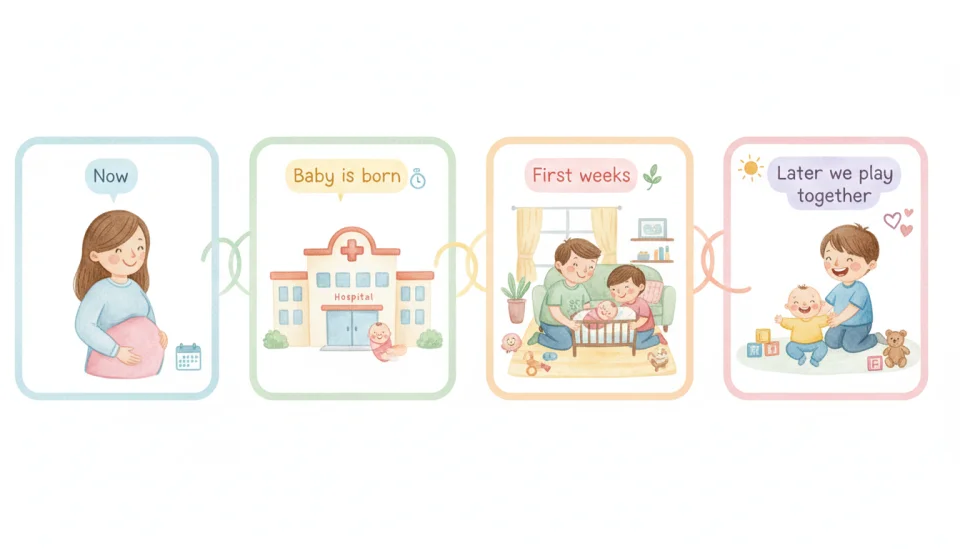
Be honest but positive. “Yes, I will have less time. But we will find new ways to be together. Maybe you can snuggle up with us when I feed the baby, and I can read you a story.”
Frequently Asked Questions About Sibling Preparation
When should I tell my child about the pregnancy? Best after the first trimester when the pregnancy is more stable. For small children, it’s often enough for them to know about it about 3-4 months in advance – longer waiting periods are hard to grasp.
What if my child reacts with jealousy? Jealousy is normal and healthy. Name the feelings: “You’re sad because Mommy is with the baby right now.” Make sure to plan exclusive time and show understanding instead of accusations.
Should I bring gifts “from the baby”? This can help make the first encounter positive. But it’s more important that the older child feels seen – through words, hugs, and genuine attention.
How do I explain the birth itself? Age-appropriately and without scaring: “Mommy goes to the hospital so that doctors can help safely bring the baby into the world. You will stay with Daddy/Grandma and we will see each other again very soon.”
Preparing your older child for the arrival of a sibling is not a task that can be completed in one day. It is a process full of small moments: a conversation here, a role play there, a special outing in between. Each of these moments is a building block for a strong sibling relationship. You give your child the greatest gift: the assurance of being loved – no matter how much the family changes. And when you hold both children in your arms, you will know: All the preparation was worth it.
Article translated from German → View original article
Sources & Research
Research Summary
Schwangere Frauen im dritten Trimester können ihr erstgeborenes Kind emotional und praktisch auf das Geschwisterchen vorbereiten, indem sie es aktiv einbeziehen, altersgerechte Bücher und Filme nutzen, Rollenspiele fördern, besondere Ausflüge planen und einfache Erklärungen zum Familienalltag nach der Geburt geben. Ein unterstützender, inspirierender Ton hilft, Vorfreude zu wecken und Unsicherheiten abzubauen.
Sources Used
- Erstgeborene auf Geschwister vorbereiten: Hilfreiche Tipps (Accessed on 2025-11-07)
- Geschwister auf das neue Baby vorbereiten (Accessed on 2025-11-07)
- Mama bekommt ein Baby: praktische Tipps für Geschwisterkinder (Accessed on 2025-11-07)
- Zweites Kind: Tipps zur Vorbereitung aufs Geschwisterchen (Accessed on 2025-11-07)
- Familienzuwachs - 5 wichtige Tipps für die Geschwister (Accessed on 2025-11-07)
- Kind auf Geschwisterchen vorbereiten: 7 hilfreiche Tipps! (Accessed on 2025-11-07)
- Vorbereitung auf das Geschwisterchen (Accessed on 2025-11-07)
- Geschwisterchen kommt: Kind auf Geschwisterkind ... (Accessed on 2025-11-07)
- Wie bereitet man sein Kind auf das neue Baby vor? (Accessed on 2025-11-07)
Medical Disclaimer
The information provided in this article is for educational purposes only and is not intended as a substitute for professional medical advice, diagnosis, or treatment. Always seek the advice of your physician or other qualified health provider with any questions you may have regarding a medical condition. Never disregard professional medical advice or delay in seeking it because of something you have read on this website.
Similar Posts
Sibling Communication: How to Lovingly Prepare Your Child for the New Baby
Preparing your child for the arrival of a new baby is one of the most important tasks during pregnancy. With the right w...
Asking for Help in the Postpartum Period: 7 Concrete Ways Friends Can Support You Now
The baby is here, and so is the exhaustion – but asking for help is so hard. Learn how to specifically articulate what y...
Celebrating Sibling Love: 7 Cultural Rituals to Enrich Your Family Life After Birth
The first weeks with a baby are magical—and challenging for sibling children. Discover heartwarming rituals from differe...
The Spa Day for Siblings: 7 Creative Ways to Enjoy the Postpartum Period Together
The postpartum period with multiple children? Turn the challenge into an opportunity: A spa day at home gives siblings a...