
It's Saturday morning. You barely slept the whole night because your little one is teething. Now there's a mountain of laundry in front of you, breakfast is stuck to the floor, and you feel your jaw tightening. Just hold on a little longer, you think. But what if this holding on isn’t good for either you or your child in the long run? The good news: When you learn to take care of yourself, you give your child the most valuable gift of all – a balanced, present mom or dad.

Why Self-Care Is Not Selfish – But an Act of Love
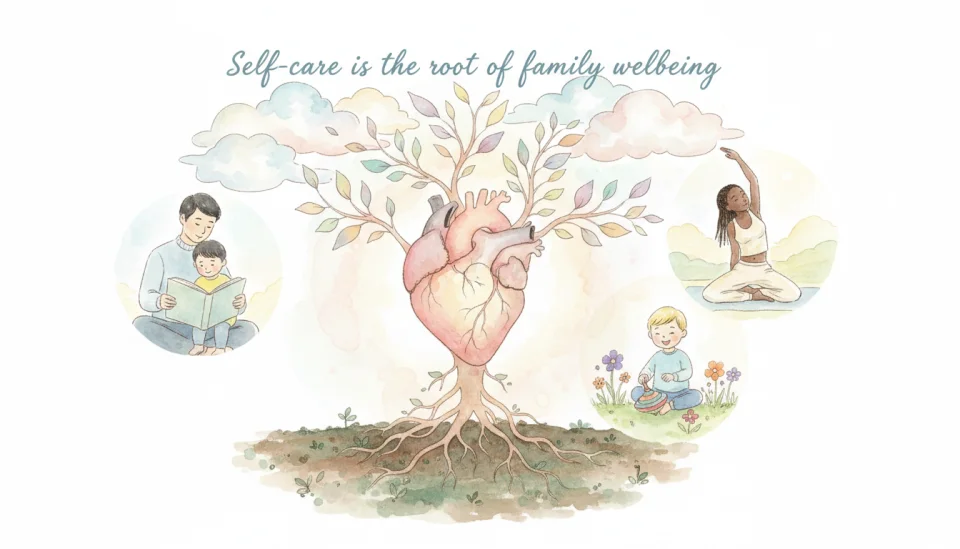
Many parents feel guilty when they think about themselves. But self-care is not selfish – it is the foundation for a healthy family. Studies show that the better you feel, the more energy you have for your relationship and your child. When you are balanced, you can respond to conflicts more calmly and provide your child with emotional security.
Self-care doesn’t mean you have to go to the spa every day or meditate for hours. It’s about knowing your own needs and boundaries – and respecting them. Only those who recharge their inner battery can truly give to others.
What Happens When You Neglect Yourself?
If your needs are ignored for an extended period, it can have serious consequences:
- Physical Exhaustion: Chronic fatigue, headaches, tension
- Emotional Overload: Irritability, impatience, tears without a clear reason
- Psychological Problems: Burnout, panic attacks, depression
- Effects on the Family: More conflicts, less patience, tense atmosphere
Your well-being has a direct impact on your child's happiness. Children intuitively sense when you’re not well – and it unsettles them.

How to Recognize Your Own Needs – Even in Chaos
Many parents have forgotten to pay attention to their inner signals. The first step toward self-care is: Reconnect with yourself. Sounds abstract? Here are concrete ways:
Recognizing Physical Signals
Your body constantly sends messages. Learn to interpret them:
- Tight neck? You’re carrying too much weight alone.
- Shallow breathing? You're in stress mode.
- Constantly hungry or lacking appetite? Your emotional needs aren’t being met.
- Sleeping problems? Your nervous system can’t calm down.
Take 2 minutes daily to consciously feel into your body. Close your eyes, take a deep breath, and ask yourself: What do I really need right now?
Establishing Emotional Check-Ins
Regularly ask yourself:
- When did I last really feel good today?
- What drained my energy today?
- Which need went unfulfilled today?
- What would feel good for me right now?
Write down your answers – even if it’s just keywords. This helps you develop a feel for your patterns.

Practical Self-Care Strategies for Family Life
Self-care doesn’t have to be complicated. Here are practical strategies that really work:
Micro-Moments of Restoration
You don't need hours — even small islands in your day make a difference:
- Morning Ritual (5 min.): Drink your coffee mindfully before the chaos begins.
- Breathing Exercise (2 min.): Inhale for 4 seconds, exhale for 6 seconds – it calms your nervous system immediately.
- Movement Snack (3 min.): Stretch, dance to a song, shake your body.
- Nature Moment (5 min.): Step outside briefly, feel the wind or sun on your skin.
Setting Boundaries – Without Guilt
Setting boundaries is a form of self-care. Practice saying no kindly but firmly:
- "I need 10 minutes for myself now, then I will be back for you."
- "I can't manage that today – can we postpone?"
- "I want to go to bed early tonight, who will take the goodnight story?"
Important: Explain your boundaries, but don’t justify them endlessly. You are allowed to have needs.
Accepting Support
You don’t have to do everything alone:
- Ask your partner specifically for help (not “Can you...?” but “Please take care of the bath today.”).
- Swap caregiving times with other parents.
- Invest in help if possible (cleaning service, babysitter, delivery service).
- Use digital tools for mental relief (shopping list apps, meal prep).

You are the Most Important Role Model for Your Child
Here comes the most powerful truth: Your child learns the most by observation – not by words. When you treat yourself with care, you teach your child that self-care is normal and important.
Children whose parents practice self-care learn:
- To perceive and communicate their own needs
- To set and respect boundaries
- That it's okay to need help
- That breaks are not a weakness, but a strength
- That self-love is the foundation for healthy relationships
So you do not give your child less when you take care of yourself – you give them more. More presence, more patience, more genuine connection.
Your Action Plan: Small Steps, Big Impact
Self-care begins with a decision – and then with small, concrete steps:
- This week: Choose ONE micro-habit (e.g., consciously breathe 3 times daily) and stick to it.
- This month: Talk to your partner about a fixed "me time" each week (even if it’s only 30 minutes).
- In the long term: Build a support network – people who understand and relieve you.
Remember: Self-care is not a luxury, but a necessity. You are not only a mother or father – you are also a human being with your own needs. And when you take care of yourself, you automatically take better care of your family.
Your child doesn’t need perfect parents. They need parents who don’t lose themselves – and who show that love also means self-love.
Article translated from German → View original article
Sources & Research
Research Summary
Selbstfürsorge bei Eltern ist essenziell, um langfristig das eigene Wohlbefinden, die Partnerschaft und die psychische Gesundheit der Kinder zu fördern. Eltern, die ihre eigenen Bedürfnisse wahrnehmen und erfüllen, sind ausgeglichener, können besser auf ihre Kinder eingehen und dienen als positives Vorbild für die Entwicklung der Selbstfürsorge bei ihren Kindern.
Sources Used
- Selbstfürsorge | Kinderschutz Schweiz (Accessed on 2025-10-23)
- Eltern & Selbstfürsorge - nestliebe (Accessed on 2025-10-23)
- SELBSTFÜRSORGE und WARUM SIE SIE BRAUCHEN - GEGE (Accessed on 2025-10-23)
- Elternsein & Selbstfürsorge – Warum du dich selbst nicht verlieren darfst (Accessed on 2025-10-23)
- geborgen-wachsen.de/2024/04/17/warum-selbstfuersorge-gerade-fuer-eltern-wichtig-ist/ (Accessed on 2025-10-23)
- elterncoach-oldenburg.de/die-bedeutung-der-selbstfuersorge-fuer-eltern/ (Accessed on 2025-10-23)
- www.famplus.de/gast/wissenswertes/blog/node/907227 (Accessed on 2025-10-23)
- krisen-kiste.com/selbstfuersorge-in-der-erziehung/ (Accessed on 2025-10-23)
- mamaleicht.ch/selbstfuersorge-im-alltag-fuer-eltern/ (Accessed on 2025-10-23)
Medical Disclaimer
The information provided in this article is for educational purposes only and is not intended as a substitute for professional medical advice, diagnosis, or treatment. Always seek the advice of your physician or other qualified health provider with any questions you may have regarding a medical condition. Never disregard professional medical advice or delay in seeking it because of something you have read on this website.
Similar Posts
Sibling Communication: How to Lovingly Prepare Your Child for the New Baby
Preparing your child for the arrival of a new baby is one of the most important tasks during pregnancy. With the right w...
Asking for Help in the Postpartum Period: 7 Concrete Ways Friends Can Support You Now
The baby is here, and so is the exhaustion – but asking for help is so hard. Learn how to specifically articulate what y...
Celebrating Sibling Love: 7 Cultural Rituals to Enrich Your Family Life After Birth
The first weeks with a baby are magical—and challenging for sibling children. Discover heartwarming rituals from differe...
The Spa Day for Siblings: 7 Creative Ways to Enjoy the Postpartum Period Together
The postpartum period with multiple children? Turn the challenge into an opportunity: A spa day at home gives siblings a...