
The potatoes are getting cold, your daughter is crossing her arms defiantly, and your son loudly declares that vegetables are "gross." What was meant to be a cozy family dinner suddenly feels like a negotiation at the UN Security Council. You take a deep breath and wonder: Does it really have to be this way every evening? The good news: No. The family table can actually become a place where conflicts do not escalate but turn into valuable moments of learning.

Why the Family Table is the Perfect Place for Conflict Resolution
The dining table is more than just a piece of furniture – it is the stage for family life. Here, everyone comes together, different needs collide, and that’s precisely why this place is so valuable. Conflicts at the table are not a disturbance but an opportunity. They show that your children feel safe enough to express their real feelings.
When we learn to use these moments constructively, we instill life skills in our children: How do I express what bothers me? How do I listen to others? How do we find solutions together? These social skills are invaluable – and the family table is the perfect training ground for them.
Open Communication: Feelings Have a Place at the Table
"I don’t like this!" – this sentence can either be the start of a power struggle or the beginning of a genuine conversation. The difference lies in how we respond. Instead of immediately going into defense mode ("I put so much effort into this!"), we can become curious.
The Art of Active Listening
Try this technique: Reflect your child’s feelings back before offering a solution. "You’re really frustrated about the vegetables, aren’t you?" This simple acknowledgment works wonders. Your child feels seen, and the tension already diminishes.
- Maintain eye contact and briefly put down your utensils – show that you are truly present
- Ask open-ended questions: "What exactly bothers you about this?" instead of "Why won’t you eat this?"
- Avoid immediate judgments – first understand, then react
- Name emotions: "You look disappointed" or "I see this is bothering you"

Learning to Name Feelings
Many children – especially younger ones – don’t yet have the words for their emotions. You can help them by building a "feeling vocabulary." "Are you frustrated because you wanted to eat something else? Or are you tired from a long day?" This way, children learn to distinguish between hunger, fatigue, disappointment, and anger.
De-escalation: When the Mood Shifts
Sometimes a conflict escalates faster than we can say "Enjoy your meal." Sibling arguments flare up, tears flow, or a child storms away from the table. In such moments, your calmness is the anchor.
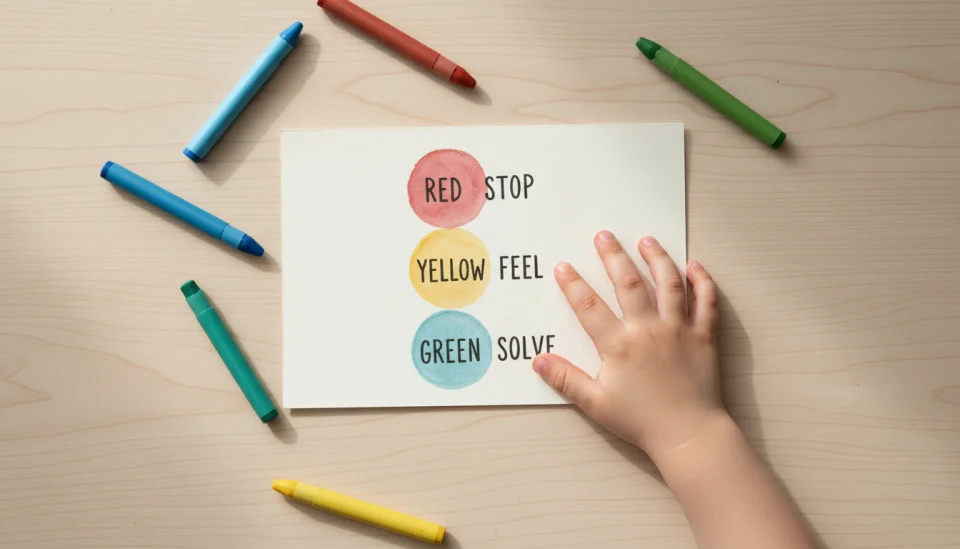
The Traffic Light Method
Introduce a simple system that even younger children can understand:
- Red: Stop – let’s take a short break. Everyone takes three deep breaths.
- Yellow: Everyone gets to say how they feel – without interruption.
- Green: Together we think about how we can move forward.
This structure provides safety and prevents emotions from taking over. You can even make small traffic light cards to place in the center of the table – this way, children can also signal when they need a break.
Strategies for Heated Moments
- Consciously lower your voice – loud reactions only escalate conflicts
- Name what you see: "I notice things are getting loud. Let’s all take a moment to breathe."
- Offer a retreat space: "Would you like to go to your room for a moment to calm down?" (without punishment!)
- Postpone complex discussions: "This is an important topic. Let’s discuss it calmly after dinner."
Role-Playing: Practicing Conflicts Playfully
It may sound unusual, but role-playing outside of conflict situations is incredibly effective. When everyone is relaxed – perhaps on a weekend during breakfast – you can act out typical dining conflicts.
"Imagine you are me, and I am you. You just cooked vegetables, and I say I don’t like them. What would you say now?" Children love to step into the parent role and learn a lot about perspective-taking in the process. Often, surprising insights come up: perhaps you discover that your child wishes to have more say in what they eat.
- Switch roles: parents become children, children become parents
- Act out exaggerated scenarios – humor lightens the mood and makes learning easier
- Collect solution ideas together: "What could I do differently? What could you do differently?"
- Celebrate small successes: "Last week we handled that really well, remember?"

Your Role Model Function: Children Learn by Observing
Here comes the uncomfortable truth: Our children will not do what we say – they will do what we do. When we become loud during conflicts, interrupt our partners, or speak disparagingly about others, our children learn exactly that.
The good news: You don’t have to be perfect. In fact, your mistakes are valuable learning moments when you address them openly. "Sorry, I wasn’t listening well. Can you say that again?" Such sentences show your children that even adults work on themselves – and that apologies are a sign of strength, not weakness.
Creating Concrete Role Model Moments
- Talk about your own feelings: "I’m feeling frustrated because the day has been stressful. I need a moment."
- Show how you handle disappointments: "It’s a shame that the food burnt. Well, it happens. What should we do now?"
- Resolve conflicts with your partner respectfully – even when children are watching
- Admit mistakes: "You’re right, I interrupted you. I’m sorry."
Follow-Up Discussions: The Underrated Key to Success
What happens after the conflict is at least as important as the conflict resolution itself. Follow-up discussions create understanding and reinforce what has been learned. This does not need to be a formal session – a short conversation while clearing the table or before bedtime is sufficient.
"What was difficult for you at the table today? What went well?" These questions invite reflection without accusation. You can also share your perspective: "I appreciated it when you expressed what was bothering you instead of just walking away. That helped me understand you."

Structure for Effective Follow-Up Discussions
- Timing: Not immediately after the conflict, but when everyone is calm
- Appreciation first: Start with something positive – "Thank you for telling me how you feel"
- Analyze together: "What happened? How did we feel? What could we do differently next time?"
- Develop solutions: Not just you alone, but together with the child
- Find closure: "I’m glad we talked about this. I love you."
These rituals show your children that conflicts are normal and that there is always a way back to connection. They learn that relationships do not break through disagreements, but can become stronger.
Small Steps, Big Impact
Change takes time. You won’t have a conflict-free family table overnight – and that’s not the goal. The goal is for conflicts to become moments of connection, where your children learn to manage emotions, understand others, and find solutions together.
Start with a single element from this article. Maybe you introduce the traffic light method. Or you make it a point to reflect feelings before reacting in conflicts. Every small step counts, and your children will notice.
The family table can indeed become a place of peace – not because there are no longer any conflicts, but because you have learned to handle them with love. And that is a gift that will accompany your children for their entire lives.
Article translated from German → View original article
Medical Disclaimer
The information provided in this article is for educational purposes only and is not intended as a substitute for professional medical advice, diagnosis, or treatment. Always seek the advice of your physician or other qualified health provider with any questions you may have regarding a medical condition. Never disregard professional medical advice or delay in seeking it because of something you have read on this website.
Similar Posts
Sibling Communication: How to Lovingly Prepare Your Child for the New Baby
Preparing your child for the arrival of a new baby is one of the most important tasks during pregnancy. With the right w...
Asking for Help in the Postpartum Period: 7 Concrete Ways Friends Can Support You Now
The baby is here, and so is the exhaustion – but asking for help is so hard. Learn how to specifically articulate what y...
Celebrating Sibling Love: 7 Cultural Rituals to Enrich Your Family Life After Birth
The first weeks with a baby are magical—and challenging for sibling children. Discover heartwarming rituals from differe...
The Spa Day for Siblings: 7 Creative Ways to Enjoy the Postpartum Period Together
The postpartum period with multiple children? Turn the challenge into an opportunity: A spa day at home gives siblings a...