
It’s Sunday noon, the family is finally sitting together at the table – and then the drama begins: Your four-year-old is shoveling peas with their fingers, your daughter is talking with her mouth full about her morning at kindergarten, and the fork ends up somewhere on the floor. You take a deep breath and wonder: Will this ever get better? The good news: Yes! Table manners are not magic but a skill that children can learn playfully – with the right strategies, plenty of patience, and a pinch of humor.

Simple Rules: The Magic of a Shared Start
Before the first utensils are picked up, a meal starts with an important ritual: the shared start. Preschoolers love rituals – they provide security and structure. Explain to your child that everyone waits until everyone is seated and the food is on the table. A simple "Enjoy your meal!" or a brief moment of pause signals: This is when our shared time begins.
Some families let each child briefly share what they are looking forward to today or what nice thing they experienced – this creates connection and teaches listening to others. Washing hands before and after meals is also incorporated, and wiping the mouth with a napkin becomes a natural habit.
- Start together: No one begins eating until everyone is seated at the table.
- Wash hands: Before and after meals – best to go to the sink together.
- Stay seated: Remain at the table until everyone is finished (with age-appropriate flexibility).
- Say thank you: For the food and the person who cooked it.
The Proper Use of Utensils: Playfully Mastering the Skills
Knife, fork, spoon – for small hands, these tools can initially be real challenges. Instead of strict lessons, playful learning works best here. A wonderful method: Make colorful cardboard utensils together and play "Restaurant." Your child gets to be the waiter or waitress and set the table – fork on the left, knife on the right, spoon next to it. This way, they learn where things belong without it feeling like a lesson.

When it comes to real meals, patiently show them how to hold the fork – not like a pencil, but with the whole hand. The knife comes in later when their fine motor skills have further developed. For starters, it’s sufficient for your child to learn to eat with a fork instead of their fingers (except of course for finger food!).
Practical Cutlery Tips for Everyday Life
- Use child-sized utensils: Smaller, lighter forks and spoons make handling easier.
- Be a role model: Eat mindfully with utensils yourself – children learn by imitation.
- Have patience: It’s normal for things to get messy at first.
- Create success experiences: Start with simple foods (pasta, soft vegetable pieces).
- Repeat the restaurant game: Regular practice without pressure reinforces abilities.
Talking While Eating: Why a Full Mouth Should Be Silent
"Mom, do you know what?" – and already it's spilling out of your child while their mouth is still full of mashed potatoes. Every parent knows this phenomenon. Children are naturally talkative and don’t intuitively understand why they should wait to share. Here a child-friendly explanation helps: "When you talk with a full mouth, we can’t understand you well, and the food might go down the wrong way."
Even better, it works when you phrase it positively: "I’d love to hear what you experienced – but first, when you’ve finished chewing, then I can understand you really well!" This transforms the rule from a prohibition into a request that is much easier to follow. At the same time, your child learns that table conversations are important – just at the right moment.

Conversation Rules at the Family Table
- Wait until the mouth is empty: Swallow first, then speak.
- Listen to each other: Don’t interrupt when someone is talking.
- Take turns speaking: Everyone gets a turn – including the little ones.
- No loud noises: Avoid smacking and burping (unless it happens accidentally, then say "Excuse me").
Practical Exercises: Table Games for Patience and Politeness
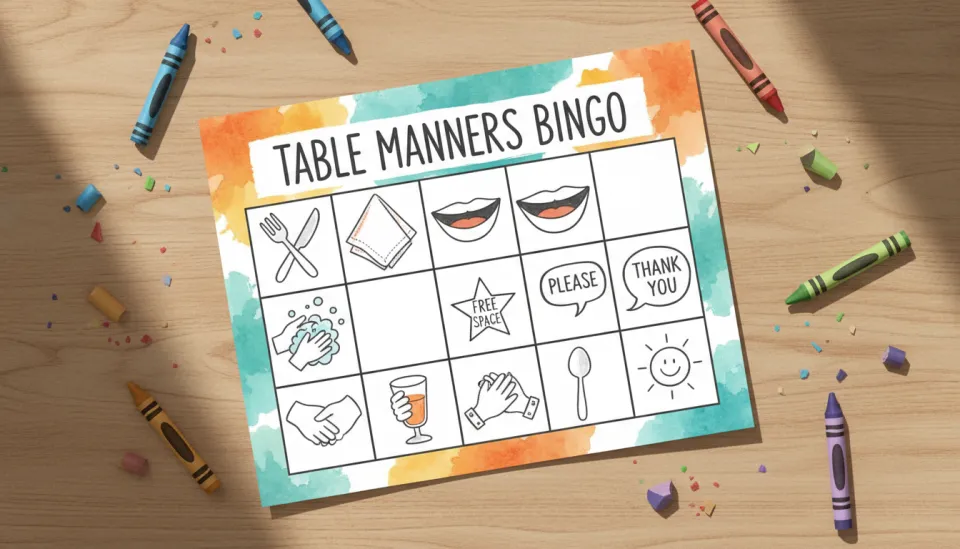
Kids learn best when it’s fun. That’s why table games are a wonderful tool to train patience, politeness, and social skills. The previously mentioned "Restaurant game" is just the beginning. You can also create a "Manners Bingo": Draw a grid with different good table manners (using a napkin, holding the fork correctly, speaking with an empty mouth, saying "please" and "thank you") – and each time your child expresses one of them, they can check off a box.
Another game: "The Magic Plate". Explain that the plate is a special place from which the food does not want to fall off. Your child tries to eat so carefully that nothing spills. Or try the "Silent-Post Meal": Each person takes turns quietly saying a wish or compliment to the food – this promotes mindfulness and makes the meal special.
Game Ideas for the Dining Table
- Restaurant Game: Set the table, take orders, serve politely.
- Manners Bingo: Collect and check off good manners.
- Magic Plate: Nothing is allowed to fall – practice concentration.
- Compliment Round: Everyone says something nice about the food or the person next to them.
- Patience Training: Wait until everyone is served – then start together.
Reward System: Positive Reinforcement of Good Manners
Punishments and scolding do little for table manners – positive reinforcement works wonders. When your child notices that good behavior brings recognition, they are motivated to continue. This can be as simple as an honest "Wow, you ate so well with your fork today!" or "I saw how patiently you waited – that was great!"
For some families, a sticker system works: For every meal where specific rules are kept, there’s a sticker on a chart. After a week full of stickers, the child can choose a small reward – perhaps a trip to the playground or an extra story time. It’s important that the reward doesn’t have to be material; often, time spent together is the most valuable.
Also explain to your child the "why" behind the rules: "When we are polite at the table, everyone feels good, and the food tastes so much better!" Thus, a regulation transforms into a heartfelt request – which is much easier to follow.

Ideas for Positive Reinforcement
- Verbal Praise: Specifically name what was good ("You waited so nicely!").
- Sticker Chart: Visual successes collected.
- Shared Rewards: Family outings or a special dessert.
- Be a Role Model: Show good manners yourself – children imitate.
- Maintain Patience: Setbacks are normal; stay lovingly consistent.
Table manners are not training, but a loving learning process that takes time. Every child develops at their own pace, and that’s perfectly fine. With playful methods, clear but friendly rules, and lots of positive reinforcement, the chaotic dining table will gradually transform into a place where everyone feels comfortable – and where your child simultaneously learns important social skills for life. So: Take a deep breath, pick up the fork, and start together. You can do this!
Article translated from German → View original article
Sources & Research
Research Summary
Eltern können Vorschulkindern spielerisch grundlegende Tischmanieren beibringen, indem sie einfache Regeln wie das Vorstellen am Tisch, den richtigen Umgang mit Besteck und das Vermeiden von Sprechen mit vollem Mund vermitteln. Praktische Übungen und Tischspiele fördern Geduld und Höflichkeit, während ein Belohnungssystem positive Verhaltensweisen verstärkt.
Sources Used
- Wie lernen Kinder Tischmanieren? - HABA Magazin (Accessed on 2025-11-06)
- Wie Kinder Tischmanieren spielerisch lernen - Plenty (Accessed on 2025-11-06)
- Wie Kinder einfach Tischmanieren lernen - Zewa (Accessed on 2025-11-06)
- Tischmanieren für Kinder - Regeln beim Essen - Mamaskind (Accessed on 2025-11-06)
- Wie Eltern ihren Kindern Tischmanieren beibringen (Accessed on 2025-11-06)
- Wie bringe ich meinem Kind Tischmanieren bei? (Accessed on 2025-11-06)
- KinderKnigge | Tischmanieren (Accessed on 2025-11-06)
- Zu Tisch, Kinder! (Accessed on 2025-11-06)
Medical Disclaimer
The information provided in this article is for educational purposes only and is not intended as a substitute for professional medical advice, diagnosis, or treatment. Always seek the advice of your physician or other qualified health provider with any questions you may have regarding a medical condition. Never disregard professional medical advice or delay in seeking it because of something you have read on this website.
Similar Posts
Sibling Communication: How to Lovingly Prepare Your Child for the New Baby
Preparing your child for the arrival of a new baby is one of the most important tasks during pregnancy. With the right w...
Asking for Help in the Postpartum Period: 7 Concrete Ways Friends Can Support You Now
The baby is here, and so is the exhaustion – but asking for help is so hard. Learn how to specifically articulate what y...
Celebrating Sibling Love: 7 Cultural Rituals to Enrich Your Family Life After Birth
The first weeks with a baby are magical—and challenging for sibling children. Discover heartwarming rituals from differe...
The Spa Day for Siblings: 7 Creative Ways to Enjoy the Postpartum Period Together
The postpartum period with multiple children? Turn the challenge into an opportunity: A spa day at home gives siblings a...