You’re sitting on the sofa, the newborn at your breast, and you notice how suddenly your firstborn starts speaking in a baby voice again or throws toys across the room. Jealousy is here – palpable, challenging, and sometimes heart-wrenching. But you are not alone with this feeling, and there are loving ways to navigate this phase together. With the right strategies, the challenge can become an opportunity to strengthen your family ties even more.

Recognizing Jealousy: The Quiet and Loud Signals from Your Child
Jealousy manifests differently in every child. Some suddenly become clingy again, others withdraw or test boundaries in new ways. Recognizing these signs is the first step to responding empathetically – not seeing it as a problem, but as a normal emotional reaction to a big change.
Typical Behavioral Signs in the Postpartum Period
- Regression: Your child suddenly wants to be fed again, speaks babyishly, or wants to return to diapers.
- Demanding Attention: Loud behavior right when you're breastfeeding or changing the baby.
- Physical Clinginess: Excessive clinginess or, conversely – deliberately distancing themselves.
- Aggression: Hitting, biting, or rough touching towards the baby (often driven by curiosity, not malice).
- Emotional Outbursts: More frequent crying, tantrums over minor issues.
- Changed Sleeping Behavior: Sudden sleep problems or waking up at night.
It's important to understand: These reactions are not manipulative. Your child is processing an existential change – they need to learn to share love without fearing they will lose it. Name the feelings lovingly: "I see you’re sad because I’m holding the baby. That’s okay. I love you just as much as before."

Strengthening Bonds: Shared Rituals for Older Siblings
The postpartum period is not just for the baby – it’s also a precious opportunity to deepen your relationship with your older child. Small, conscious rituals show: "You are important. You are seen. My love for you is unwavering."
Exclusive Mama or Papa Time
Schedule 10-15 minutes daily that belong only to your older child – without the baby, without your phone, without multitasking. This can be:
- Reading a picture book together while the baby sleeps.
- Having a cup of "grown-up tea" together and talking about the day.
- A short active game: pillow fight, tickling, dancing.
- A special cuddle time just for the two of you before bedtime.
These moments don’t have to be perfect or long – quality trumps quantity. Your child will feel: "I’m still important. Mom has time for me."
Actively Involve the Sibling
Turn your older child from "competitor" to "valuable helper":
- Let them fetch diapers or soothe the baby with a toy.
- Sing songs for the baby together – the older sibling can choose the songs.
- Explain care steps: "Look, this is how we gently wipe the eyes. Can you show me how gentle you can be?"
- Bathing together (if possible): the older sibling can pour water or hand over toys.
- Let them take photos: "You are the official family photographer!"
Through this involvement, pride replaces jealousy – your child feels capable and valued.
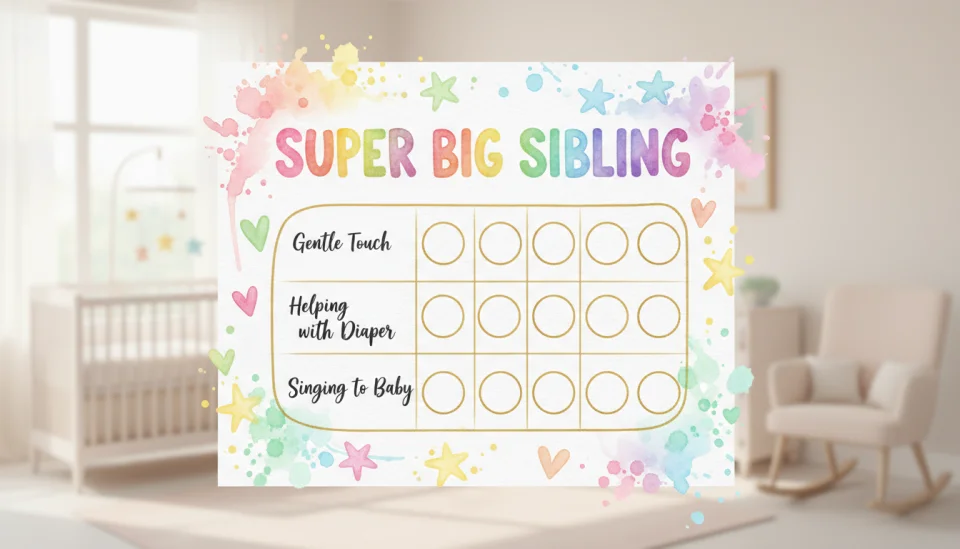
A Loving Reward System: Positive Reinforcement Instead of Punishment
A sibling reward system is not a bribery system, but a way to make desired behavior visible and celebrate it. It helps your child understand: "When I am gentle, I get recognition."
How to Create a Simple System
Keep it simple and age-appropriate:
- Sticker Chart: For every gentle gesture, every patient wait, every help, there’s a sticker. After 5 stickers comes a small reward (extra playtime, favorite snack, outing to the playground).
- "Big Brother/Sister" Badge: A handmade badge that your child can wear when they have been especially helpful.
- Praise Cards: Small cards with drawn hearts or stars that you distribute spontaneously: "That was so sweet how you smiled at the baby!"
- Celebrate Shared Successes: At the end of the week, look at the stickers together: "Wow, you were gentle 8 times this week. I’m so proud of you!"
Important: Don’t just reward behavior towards the baby, but also general cooperation – brushing teeth, tidying up, patience. This way, the system won't be too baby-centered, and your child feels seen in their entirety.
What to Avoid
- No punishment for jealousy – it’s a feeling, not misconduct.
- No comparisons: "Look, the baby doesn’t cry as much as you do."
- No exaggerated expectations: Your child is still little and allowed to make mistakes.

Opening Communication: Allowing Discussion of Feelings
Children need permission to have all their feelings – even the difficult ones. When you create a safe space for jealousy, anger, and sadness, your child learns to regulate these emotions rather than suppressing or acting them out.
Conversation Starters for Different Age Groups
For 2-3-year-olds:
- "Sometimes you might be sad when Mommy holds the baby. That’s okay. Can you show me how sad?" (Draw or mimic faces).
- Use picture books about siblings as conversation starters.
- Name the feelings: "You are angry right now. It’s okay to be angry. Hitting is not okay. Let’s stomp together!"
For 4-6-year-olds:
- "What do you think it’s like to be a big sibling? What do you like about it? What is difficult?"
- "If you had a magic wand, what would you change about the baby’s day?"
- Draw a "Feelings Diary" together: every day draw a face (happy, sad, angry) and talk about it.
Validation is key: "I understand that sometimes you wish the baby wasn’t there. That’s a normal feeling. And I love you anyway – always."
Expressing Feelings Physically
Sometimes children lack the words. Offer alternative forms of expression:
- An anger pillow to hit.
- Stomping, running, hopping for big feelings.
- Painting or kneading as emotional expression.
- Labeling "feeling weather": "What’s your weather like today? Sunny? Thunderstorms?"

Role-Playing: Practicing the Future Playfully
You can start role-playing before birth – and continue in the postpartum period. Play is the language of children, and through role-playing, they process fears and practice new situations in a safe framework.
Role-Playing Ideas for Preparation
- Puppet Play: A doll becomes the "baby." Your child gets to feed, change, and soothe the doll – and can also "scold" or set it aside when they’re annoyed.
- Switching Roles: You play the jealous sibling, and your child plays Mommy/Daddy. How would they react? What would they say?
- "What if" scenarios: "What do we do if the baby cries while you want to play with me?" Find solutions together.
- Practice Gentle Touches: Show with a doll or stuffed animal: "This is how we stroke gently. Can you do it too?"
- Sound Game: Imitate baby sounds (crying, cooing), laugh about it, and alleviate fears.
Role-Playing in the Postpartum Period
Even when the baby is there, play remains important:
- "Playing hospital": The older sibling is the doctor and examines the doll (or the real baby under supervision).
- "Being a big sibling": Your child shows the doll how great they can do everything that the baby still needs to learn.
- "Feelings Theater": Act out and name different feelings together.
Through these games, you give your child control and competence in a situation where they often feel powerless.
Your Feelings Matter Too: Self-Care in the Sibling Chaos
You are currently juggling the needs of a newborn, a jealous child, your own postpartum recovery, and perhaps even a partner or household. It’s okay to feel overwhelmed. It’s okay not to master every moment perfectly.
Allow yourself to:
- Ask for help – grandparents, friends, partners can keep the older sibling entertained while you are with the baby.
- Take breaks – even if it’s just 5 minutes in the bathroom.
- Be imperfect – sometimes the TV runs longer, sometimes there’s fish sticks instead of vegetables.
- Have your own feelings – sadness, guilt, and feeling overwhelmed are normal.
You are doing great – even if it doesn’t always feel that way. Every day you try to meet both children’s needs is a success. Every loving gesture counts, even if a tantrum is happening alongside it.
The Path to Sibling Love: Patience and Trust
Jealousy in the postpartum period is not a phase you need to "solve" – it is a natural part of adjusting. With the right tools – recognizing, involving, communicating, playing, rewarding – you create a foundation for a loving sibling relationship.
There will be days when everything runs harmoniously, and days when you think: "What was I thinking, having a second child?" Both days are normal. Both days are part of the journey.
Trust that with each passing day, your older child grows a little more into the new role. Jealousy will not disappear overnight, but it will transform – into curiosity, into pride, into love. And one day, you will watch them giggle together and think: "It was worth it. Every tear, every difficult moment – this here was worth it."
You are not alone on this journey. Thousands of mothers are walking it with you – with all the doubts, the tears, the small victories. And you can do this. Together.
Article translated from German → View original article
Medical Disclaimer
The information provided in this article is for educational purposes only and is not intended as a substitute for professional medical advice, diagnosis, or treatment. Always seek the advice of your physician or other qualified health provider with any questions you may have regarding a medical condition. Never disregard professional medical advice or delay in seeking it because of something you have read on this website.
Similar Posts
Sibling Communication: How to Lovingly Prepare Your Child for the New Baby
Preparing your child for the arrival of a new baby is one of the most important tasks during pregnancy. With the right w...
Asking for Help in the Postpartum Period: 7 Concrete Ways Friends Can Support You Now
The baby is here, and so is the exhaustion – but asking for help is so hard. Learn how to specifically articulate what y...
Celebrating Sibling Love: 7 Cultural Rituals to Enrich Your Family Life After Birth
The first weeks with a baby are magical—and challenging for sibling children. Discover heartwarming rituals from differe...
The Spa Day for Siblings: 7 Creative Ways to Enjoy the Postpartum Period Together
The postpartum period with multiple children? Turn the challenge into an opportunity: A spa day at home gives siblings a...