
Your toddler throws themselves on the floor in the supermarket because they can't have chocolate. Your preschooler cries bitterly because their tower has fallen. Your school-aged child retreats because they're in a fight with their best friend. Emotional outbursts are part of childhood – and they are not a sign of weakness but of development. The good news: You can support your child in becoming emotionally strong. Not by teaching them to suppress feelings, but by encouraging them to understand and regulate them.

What Does It Mean to Be Emotionally Strong?
Emotionally strong children are not those who are never angry, sad, or afraid. They are the ones who can recognize, name, and manage their feelings. This ability is known as emotional regulation – and it is closely linked to resilience, the mental strength that helps children face challenges and grow from them.
Even in their first year of life, babies can express feelings like joy, anger, sadness, and fear. By the end of their first year, they even begin to recognize what others react to emotionally. However, the ability to clearly name emotions – both in themselves and in others – develops during the preschool years between ages 3 and 5. And full self-regulation? It matures over many years, as it is closely tied to the development of the prefrontal cortex, the part of the brain responsible for impulse control and conscious thought.
The Benefits of Emotional Strength
Children who learn to recognize and express their feelings benefit for a lifetime:
- They resolve conflicts more constructively and find creative solutions
- They form deeper, more stable friendships
- They deal with setbacks more confidently
- They develop greater empathy and social competence
- They are mentally more resilient during crises
How Children Learn Emotional Regulation: The Role of Caregivers
The good news: Emotional regulation can be learned – and you as a mother or father play the main role. Your child doesn't learn through lectures, but through co-regulation: You reflect their feelings, name them, and show them how to deal with them.

Emotional Coaching in Daily Life
Emotional coaching means taking your child's feelings seriously, naming them, and supporting them – without judging or suppressing them. Research shows: Emotional coaching by caregivers sustainably promotes a child's emotional development. Here's how to implement it:
- Name Feelings: “I see you are really angry because the tower has fallen."
- Validate: “It’s okay to be sad. I totally understand."
- Offer Physical Closeness: “Would you like a hug?"
- Find Solutions Together: “What could help you feel better right now?"
- Be a Role Model: “I also feel frustrated sometimes. Then I take a deep breath."
Importantly: Emotional coaching does not mean allowing every behavior. Boundaries remain – but feelings can always be present. “You are allowed to be angry, but I won't allow you to hit. Let's find another way."
Building Resilience: 5 Pillars for Inner Strength
Resilience – the ability to cope with crises and emerge stronger – does not develop overnight. It grows through many small experiences in daily life. These five pillars help you promote your child's resilience:
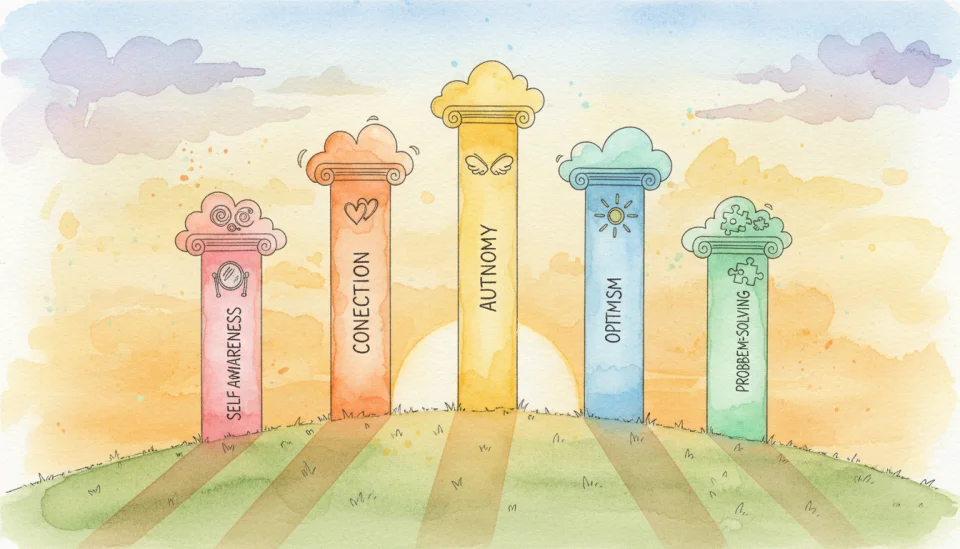
1. Strengthen Self-Awareness
The better your child knows themselves, the better they can understand their reactions. Regularly ask: “How do you feel right now?" or use feeling cards, mood meters, or creative expressions like painting or dancing.
2. Secure Attachment as a Foundation
Children who know they are loved unconditionally dare to try new things and make mistakes. Your reliable presence is the safest harbor from which your child can explore the world.
3. Promote Autonomy
Let your child make age-appropriate decisions: Which shirt should I wear? Which book shall we read? Which activity shall I choose this afternoon? Self-efficacy – the feeling of being able to make a difference – is a resilience booster.
4. Cultivate Optimism
Help your child see the positive even in difficult situations. Not as sugarcoating, but as realistic hope: “That was hard today. But you didn’t give up. Tomorrow we'll try again."
5. Develop Problem-Solving Skills
Instead of solving problems for your child, guide them in finding their own solutions. “What could you do the next time you feel this way?” This question strengthens their confidence in their own abilities.
Practical Rituals for Everyday Life
Emotional regulation and resilience grow through repetition and rituals. Here are concrete ideas you can implement immediately:

- Feeling Check-in at Dinner: Each family member shares how they felt today and why.
- Breathing Exercises as a Ritual: “Smell the flower, blow out the candle” – inhale deeply, exhale slowly. Suitable even for toddlers.
- Feeling Journal: Older children can draw or write about what moved them.
- Cuddle and Reading Time: Regular closeness strengthens emotional bonds and provides security.
- Gratitude Round Before Bedtime: “What am I thankful for today?” promotes positive thinking.
- Movement as an Outlet: Dancing, jumping, running – movement helps process emotions physically.
Frequently Asked Questions: Emotional Regulation and Resilience
Many parents have similar questions when it comes to their children's emotional development. Here are answers to the most common:
At what age can my child regulate emotions?
The ability to regulate emotions develops gradually and is closely related to brain maturation. Babies need your co-regulation, toddlers learn first strategies (e.g., distraction), preschoolers begin to name feelings, and school-aged children increasingly develop self-regulation. The prefrontal cortex – our “hero brain” – matures into young adulthood. Be patient with your child and with yourself.
What if my child is very sensitive?
Highly sensitive children perceive stimuli more intensely and react more strongly to emotions – their own and others'. This is not a weakness but a strength that needs support. Create retreat spaces, reduce sensory overload, and explain to your child that their sensitivity is valuable. "You feel a lot very strongly. That makes you a special person."
How do I deal with tantrums?
Anger is a signal that a need has not been met. Stay calm, offer safety, and name the feeling: “You are very angry right now." Allow the anger but set clear boundaries against destructive behavior. Once your child has calmed down, reflect together: “What made you so angry? What would have helped you?”
Can I "spoil" my child's emotional development?
No. By taking feelings seriously and supporting them, you do not spoil your child – you give them tools for life. Children whose emotions are validated learn to regulate themselves faster. Emotional attention is not a luxury but a basic need.

Your Child is Unique – and That's Wonderful
Every child develops at their own pace. Some are naturally quieter, others more impulsive. Some need more time to process feelings, others more movement. There is no “right” or “wrong” – there is only the path that fits your child.
What matters is your loving support. When you are present, when you listen, when you name what your child feels, and when you show them that all feelings are welcome – then you lay the foundation for a life filled with emotional strength and resilience. Your child learns: I am allowed to feel. I am seen. I am okay just as I am.
And that is the greatest gift you can give them.
Article translated from German → View original article
Sources & Research
Research Summary
Emotional starke Kinder entwickeln sich, wenn sie lernen, ihre Gefühle zu erkennen, auszudrücken und zu regulieren – ein Prozess, der eng mit der Gehirnreifung und der Unterstützung durch Bezugspersonen verbunden ist[1][3]. Resilienz und Emotionsregulation entstehen durch liebevolle Begleitung, gezieltes Emotionscoaching und das Schaffen von emotionaler Sicherheit im Alltag[2][6].
Sources Used
- Früh übt sich: Wie Bezugspersonen die Emotionsregulation ihrer Kinder fördern können (Accessed on 2023-10-23)
- „Kinder sollten alle Emotionen zeigen dürfen“ - Universität Münster (Accessed on 2023-10-23)
- Was ist Emotionsregulation? Wie Kinder Gefühle lenken lernen (Accessed on 2023-10-23)
- Emotionale Entwicklung des Kindes | kindergesundheit-info.de (Accessed on 2023-10-23)
- Emotionsregulation in der Kita im Jahr 2025 - Bildungsexperten (Accessed on 2023-10-23)
- www.kindergartenpaedagogik.de/fachartikel/psychologie/emotionsregulation-in-der-kindlichen-entwicklung-die-rolle-von-emotionen-in-der-lernerfahrung-bei-vorschulkindern/ (Accessed on 2025-10-23)
- www.projuventute.ch/de/eltern/entwicklung-gesundheit/emotionsregulation (Accessed on 2025-10-23)
- www.kita-fachtexte.de/de/fachtexte-finden/der-umgang-mit-den-eigenen-gefuehlen-die-entwicklung-der-emotionsregulation-in-der-kindheit (Accessed on 2025-10-23)
Medical Disclaimer
The information provided in this article is for educational purposes only and is not intended as a substitute for professional medical advice, diagnosis, or treatment. Always seek the advice of your physician or other qualified health provider with any questions you may have regarding a medical condition. Never disregard professional medical advice or delay in seeking it because of something you have read on this website.
Similar Posts
Sibling Communication: How to Lovingly Prepare Your Child for the New Baby
Preparing your child for the arrival of a new baby is one of the most important tasks during pregnancy. With the right w...
Asking for Help in the Postpartum Period: 7 Concrete Ways Friends Can Support You Now
The baby is here, and so is the exhaustion – but asking for help is so hard. Learn how to specifically articulate what y...
Celebrating Sibling Love: 7 Cultural Rituals to Enrich Your Family Life After Birth
The first weeks with a baby are magical—and challenging for sibling children. Discover heartwarming rituals from differe...
The Spa Day for Siblings: 7 Creative Ways to Enjoy the Postpartum Period Together
The postpartum period with multiple children? Turn the challenge into an opportunity: A spa day at home gives siblings a...