You lie on the sofa with the newborn in your arms while your three-year-old stands in the doorway, asking: "Mama, will you play with me?" Your heart aches – you want to do right by both of them, but the days in the postpartum period feel like a balancing act. The good news: With loving, simple rituals, you can lay the foundation for a deep sibling love that will accompany your children throughout their lives.

Why Rituals in the Postpartum Period Are So Powerful
In the first weeks after birth, your older child experiences a world in upheaval. Suddenly, it has to share your attention, your arms, your time. Rituals provide security – they are like little anchors in the new daily life, showing your child: "You are just as important. You belong here." At the same time, your child learns to perceive the baby not as competition but as part of the family.
Studies show that shared, recurring moments strengthen emotional bonds between siblings and reduce jealousy. The beauty of it is that these rituals do not need to be elaborate – often it is the simplest gestures that have the deepest impact.
Daily Rituals: Small Moments with a Big Impact
Morning Family Cuddle Time
Start the day with a joint cuddle in the parents' bed or on the sofa. Everyone comes together – Mom, Dad, baby, and siblings. Your older child can snuggle up to you while the baby lies on your belly or sleeps next to you. These 10-15 minutes become memorable and signal: "We are a family. Everyone has their place here."
- Let your older child gently stroke or kiss the baby
- Share what you are all looking forward to today
- Sing a song or make some playful noise – laughter connects
Reading with Mom (and Baby)
Establish a dedicated reading moment – for example, after lunch or before naptime. You sit comfortably, the baby is in a wrap or sleeps beside you, and your older child cuddles up next to you. Pick a favorite book together. Reading creates closeness, and your child experiences that even with a baby, there is time just for us.
Tip: Let your child "read" to the baby (even if they cannot read yet) – this strengthens their self-esteem and the bond with their sibling.

The Magical Sibling Basket: Engaging with Heart
A sibling basket is a simple yet brilliant idea: You assemble a basket or box with special toys, craft materials, or activities that your older child can only access when you are nursing or changing the baby. This makes those moments special rather than frustrating.
What goes into the basket?
- New markers, coloring books, or stickers
- Small puzzles, magnet games, or stacking cups
- Play dough, beading sets, or crafting paper
- A special stuffed animal or puppet
- A children's audio play or music that only plays during this time
Important: Change the contents regularly to maintain curiosity. Your child learns: "When Mom takes care of the baby, it's also my special time."
Encouraging Small Gifts Between Siblings
When visitors come, many bring a gift for the baby – and your older child looks on sadly. Turn the tables: Let your older child present a small gift to the baby (a hand-drawn picture, a rattle, a cuddly blanket). This reinforces the feeling of playing an important role.
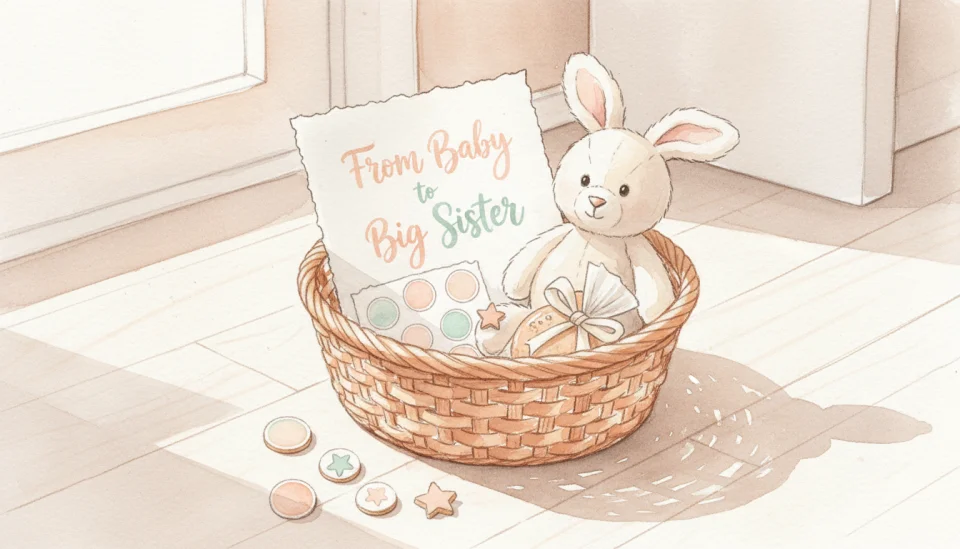
Conversely, you can also prepare a "gift from the baby": A small book, a toy, or a sticker set that "the baby" gives to the big sibling. Your child experiences: "The baby likes me. We belong together."
Quality Time in the Living Room: The Family Room as the Heart of Home
The living room often becomes the center of your family life in the postpartum period. This is where most activities happen: nursing, cuddling, playing, resting. Use this space consciously to create closeness.
Ideas for shared living room rituals:
- Build a cuddle corner together with pillows and blankets
- Have a "family tea party" in the afternoon (with cookies and juice)
- Spread out a play mat where everyone can spend time together
- Listen to music and dance gently (even with the baby in your arms)
- Look at photo albums and tell stories from when the older child was a baby
These moments create togetherness – without pressure, without perfection, just being together.
Monthly Memories: Making Sibling Love Visible
The first months fly by – and often we forget to capture the little milestones. Monthly memories help you consciously recognize and celebrate the development of the sibling relationship.
Here’s how:
- Take a photo of the siblings together once a month (same spot, e.g., on the sofa)
- Note in a small notebook: What did the older child do for the baby today? What was a special moment?
- Create a "sibling treasure chest" with keepsakes: first joint drawing, a footprint, a letter
- Celebrate small successes: "You gave the baby the rattle for the first time today!"
These rituals give your older child the feeling of being valued – and later you can reminisce together about these memories.

Your Heart is Big Enough – and So is Your Love
Perhaps you sometimes doubt whether you can really manage everything. Yet, these little loving rituals show your children: Love doesn't get divided – it multiplies. Every cuddle, every story read, every shared laugh is a building block for a sibling relationship that endures.
You don't have to be perfect. You just need to be there – with an open heart, with patience, and with the knowledge that these first weeks are the beginning of something wonderful. Your children may not remember every detail, but they will always remember how it felt: loved, seen, connected.

Article translated from German → View original article
Sources & Research
Research Summary
Im Wochenbett ist es besonders wichtig, die Bindung zwischen Geschwistern durch liebevolle Rituale zu fördern, um Eifersucht zu mindern und die Geschwister in die neue Familiensituation einzubeziehen. Praktische Rituale wie gemeinsame Kuschelzeiten, Vorlesen mit Mama, kleine Geschenke unter Geschwistern, gemeinsame Zeit im Wohnzimmer und ein spezielles Geschwisterkörbchen mit Aktivitäten helfen dabei, die Geschwisterbindung zu stärken und besondere Momente festzuhalten.
Sources Used
- Wochenbett mit Geschwistern – Wie wir sie sinnvoll einbeziehen (Accessed on 2025-11-07)
- Wochenbett mit Geschwistern: 5 Hebammen-Tipps für mehr Entspannung (Accessed on 2025-11-07)
- Tipps für das Wochenbett mit Geschwistern (Accessed on 2025-11-07)
- Wochenbett mit Geschwisterkind (Accessed on 2025-11-07)
- Wochenbett mit Geschwisterkind (Accessed on 2025-11-07)
- Tipps für das Wochenbett mit Geschwistern (Accessed on 2025-11-07)
- Wochenbett mit Geschwistern: 5 Hebammen-Tipps (Accessed on 2025-11-07)
- Wochenbetttraditionen rund um den Globus (Accessed on 2025-11-07)
- Wochenbett mit Geschwistern – Wie wir sie sinnvoll ... (Accessed on 2025-11-07)
- Geschwister-Beschäftigungen für das Wochenbett (Accessed on 2025-11-07)
- Großeltern Rituale - Baby-Vorbereitung Forum (Accessed on 2025-11-07)
- Familienzuwachs - 5 wichtige Tipps für die Geschwister (Accessed on 2025-11-07)
- wenn ältere Geschwister entthront werden (Accessed on 2025-11-07)
- Was tun mit dem Großen, wenn ich das Baby stille? (Accessed on 2025-11-07)
Medical Disclaimer
The information provided in this article is for educational purposes only and is not intended as a substitute for professional medical advice, diagnosis, or treatment. Always seek the advice of your physician or other qualified health provider with any questions you may have regarding a medical condition. Never disregard professional medical advice or delay in seeking it because of something you have read on this website.
Similar Posts
Sibling Communication: How to Lovingly Prepare Your Child for the New Baby
Preparing your child for the arrival of a new baby is one of the most important tasks during pregnancy. With the right w...
Asking for Help in the Postpartum Period: 7 Concrete Ways Friends Can Support You Now
The baby is here, and so is the exhaustion – but asking for help is so hard. Learn how to specifically articulate what y...
Celebrating Sibling Love: 7 Cultural Rituals to Enrich Your Family Life After Birth
The first weeks with a baby are magical—and challenging for sibling children. Discover heartwarming rituals from differe...
The Spa Day for Siblings: 7 Creative Ways to Enjoy the Postpartum Period Together
The postpartum period with multiple children? Turn the challenge into an opportunity: A spa day at home gives siblings a...