
You have welcomed your baby into the world – and instead of happiness, you feel empty, overwhelmed, or sad. You might even feel ashamed of it. But postpartum depression is not a weakness; it is a condition that affects many mothers. The good news: there are many professional resources in Vienna that can help you – and the sooner you seek support, the quicker you can find yourself again.

Why Professional Help is So Important
Postpartum depression is more than just the "baby blues." It can last for weeks or months and significantly disrupt your life. Many mothers hesitate to seek help – out of shame, fear, or because they think they need to be "strong." But studies show: The earlier you receive therapeutic support, the better and faster you can heal. The city of Vienna offers numerous resources tailored to your needs.
Particularly important: If you have already experienced postpartum depression, the risk of recurrence in another pregnancy is about 60%. Therefore, it makes sense to consult a trained specialist during pregnancy and proactively arrange for support.
Clinics and Specialized Ambulatory Care in Vienna
If you feel that your symptoms are severe or you urgently need professional help, specialized clinics are an excellent first point of contact.
Ottakring Clinic – Specialized Outpatient Care for Postpartum Depression
The specialized outpatient clinic at Ottakring Hospital is one of the leading facilities in Vienna for mothers with postpartum depression. Here, around 1,000 patients are treated each year, with over 6,000 patient contacts. The team offers comprehensive mental health care, from initial consultations and diagnostics to individual therapy plans. You can contact the clinic directly or get a referral from your gynecologist or family doctor.
- Comprehensive diagnostics and care
- Interdisciplinary team of psychiatrists, psychologists, and social workers
- Cost coverage by health insurance upon referral
- Crisis interventions also possible

Other Clinics and Psychiatric Departments
Other hospitals in Vienna also offer psychiatric outpatient care and counseling for mothers. These include AKH Vienna, Klinik Favoriten, and Klinik Floridsdorf. It's best to inquire by phone which facility has specialized offerings for postpartum depression.
Psychotherapists in Vienna
In addition to clinical facilities, there are many private psychotherapists in Vienna who specialize in supporting mothers after childbirth. One of them is Stefanie Hausleithner, who offers flexible appointment times and even allows you to bring your baby (up to crawling age) to the therapy session if there is no other childcare option available. Such family-friendly offerings make it easier to integrate therapy into your daily life.
How Do You Find the Right Therapist?
Choosing the right therapist is very personal. Here are some tips that can help:
- Specialization: Ensure that the therapist has experience with postpartum depression or perinatal psychology.
- Method: Learn about the therapeutic approach (e.g., talk therapy, cognitive behavioral therapy, trauma therapy). What appeals to you?
- Initial Consultation: Many therapists offer a free or affordable initial consultation. Use this to see if you feel a connection.
- Flexibility: Ask if online appointments are possible or if you can bring your baby with you.
- Insurance Provider or Private Practice: Clarify in advance whether the therapist has a public health insurance slot or if you need to pay upfront (more on this in the next section).

Cost Coverage by Health Insurance
One of the most common questions is: Who pays for therapy? In Austria, there are various options for cost coverage.
State-Financed Psychotherapy
If you get a spot with an approved psychotherapist who has a contract with the public health insurance, the health insurance covers the full costs. The downside: Public health insurance spots are scarce, and waiting times can last several months. Nevertheless, it’s worth putting your name on waiting lists – especially at specialized facilities.
Private Practice with Cost Reimbursement
Many therapists work as private practitioners, meaning you initially pay out-of-pocket and then submit the bill to your health insurance. Depending on the insurer, you will be reimbursed for a portion of the costs (usually between 21.80 to 28 euros per session). Be sure to check with your insurer beforehand about the specific conditions.
Social Insurance Providers and Subsidies
Some health insurers also offer special quotas or subsidies for psychotherapeutic treatment of postpartum depression. It is worth checking directly with your insurer or seeking support from a counseling center.
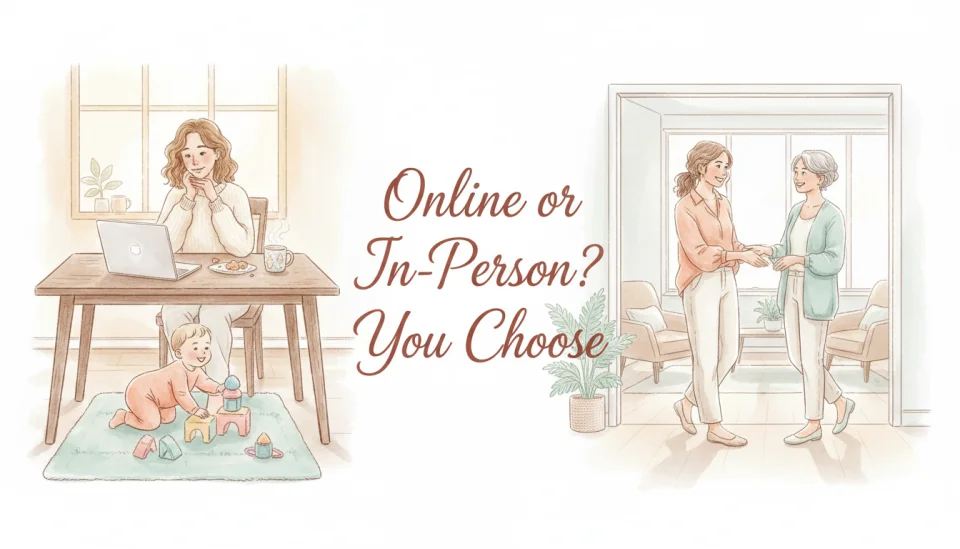
Online vs. In-Person Therapy: What Works for You?
In recent years, online therapy options have also been established in Vienna – a flexible alternative to traditional in-person therapy. Both forms have their advantages and disadvantages.
Benefits of Online Therapy
- Flexibility: You can participate from home without needing to arrange transport or childcare.
- Short-notice Appointments: Many online therapists also offer crisis interventions.
- Anonymity: Some mothers feel more comfortable online as they can stay in their familiar surroundings.
Benefits of In-Person Therapy
- Personal Contact: Direct interaction can be more intense and healing.
- Clear Separation: The journey to the practice creates a conscious space for yourself, separate from everyday life.
- Nonverbal Communication: Body language and atmosphere play an important role in therapy.
Many therapists now offer a combination of both – you can switch between online and in-person appointments as needed.
Personal Experiences: Mothers Who Took the Leap
Many mothers report that the empathetic conversation with a psychotherapist brought great relief. Step by step – in the form of a tailored conversation or trauma therapy – you can return to more joy in life. A mother from Vienna shares: "I felt so ashamed that I wasn’t happy. But in therapy, I learned that my feelings are completely normal. That took so much pressure off me."
Another mother emphasizes: "The flexibility was crucial for me. I was able to bring my baby along, and the therapist accommodated that. It made the start so much easier."
These experiences show: There is no "right" way – only the way that works for you.
Your First Step: You Are Not Alone
Postpartum depression is treatable, and many doors are open to you in Vienna. Whether it's a clinic, therapist, online, or in-person therapy – what matters is that you take the first step. You don’t have to go through this alone. Seek support, talk openly about your feelings, and trust that you will feel better with the right help.
You are a good mother – even if it doesn’t feel that way right now. And you deserve to be healthy and happy.

Article translated from German → View original article
Sources & Research
Research Summary
In Wien gibt es vielfältige Therapieangebote für Mütter mit postpartaler Depression, darunter spezialisierte Kliniken wie die Klinik Ottakring, psychotherapeutische Praxen und Mutter-Kind-Gruppen. Die Kostenübernahme durch Krankenkassen ist möglich, und sowohl Online- als auch Präsenztherapien werden angeboten. Erfahrungsberichte betonen die Bedeutung einer empathischen, individuellen Betreuung und die Wichtigkeit, frühzeitig professionelle Hilfe in Anspruch zu nehmen.
Sources Used
- Psychotherapeutische Begleitung nach der Geburt in 1150 Wien (Accessed on 2025-11-07)
- Postpartale Depression: wenn aus Babyglück plötzlich Belastung wird - Klinik Ottakring (Accessed on 2025-11-07)
- Depression nach der Geburt – Geburtsinfo Wien (Accessed on 2025-11-07)
- Postnatale Depression - Psychotherapie Wien (Accessed on 2025-11-07)
- Nach der Geburt - Mag.a Sarah Rinner (Accessed on 2025-11-07)
- Therapie mit System - Schwangerschaft und postpartale Depression (Accessed on 2025-11-07)
- Postpartale Depression - Hebammenzentrum Wien (Accessed on 2025-11-07)
- Psychische Krisen rund um Schwangerschaft und Geburt (Accessed on 2025-11-07)
- Psychologische Hilfe bei Depression - Wien (Accessed on 2025-11-07)
- Baby-Blues: Sensible Begleitung bei einer postpartalen ... (Accessed on 2025-11-07)
Medical Disclaimer
The information provided in this article is for educational purposes only and is not intended as a substitute for professional medical advice, diagnosis, or treatment. Always seek the advice of your physician or other qualified health provider with any questions you may have regarding a medical condition. Never disregard professional medical advice or delay in seeking it because of something you have read on this website.
Similar Posts
10 Natural Methods to Combat Labor Pain – That Really Empower You
The fear of labor pain accompanies many expectant mothers. However, there are effective, natural ways to alleviate pain ...
Mindfulness in Pregnancy: 12 Gentle Exercises to Accompany You Through All Phases
Pregnancy is a time of changes, anticipation, and sometimes uncertainty. Mindfulness exercises help you arrive in each p...
10 Natural Ways to Gently Alleviate Labor Pain – Without Fear
The fear of labor pain is completely normal – but you are not helpless against it. Discover 10 natural, science-based me...
Understanding Panic Attacks in Pregnancy: When Your Heart Races and Hormones Go Haywire
Suddenly your heart races, you feel short of breath, and fear overwhelms you. Panic attacks during pregnancy can be terr...