You're lying awake at night, your hand on your belly, feeling the gentle movements of your baby. But instead of anticipation, a queasy feeling sets in: What will it be like when the contractions come? Will I be able to endure the pain? These thoughts are familiar to almost all pregnant women. But here’s the good news: Your body is made for giving birth, and there are many natural methods to help you cope with pain and experience childbirth as a powerful, self-determined event.

Why Natural Pain Relief is So Effective
Labor pains are different from other pains – they have a purpose and a rhythm. Each contraction brings you closer to your baby. Natural methods harness the power of your body, promote the release of endorphins (the body's natural painkillers), and help you get into a flow rather than fight against the pain.
Many women report that through breathing, movement, and mental techniques, they not only experienced less pain but also a deep sense of self-efficacy and connection with their baby. These methods give you control and confidence – two of the most important factors for a positive birthing experience.
10 Natural Pain Relief Methods for Childbirth
1. Breathing Techniques – Your Most Powerful Tool
Deep, slow, and even breathing during contractions is likely the most popular method for relieving labor pain. It can be a powerful tool for managing contractions more effectively. By consciously breathing, you provide yourself and your baby with oxygen, relax your muscles, and shift your focus away from the pain.
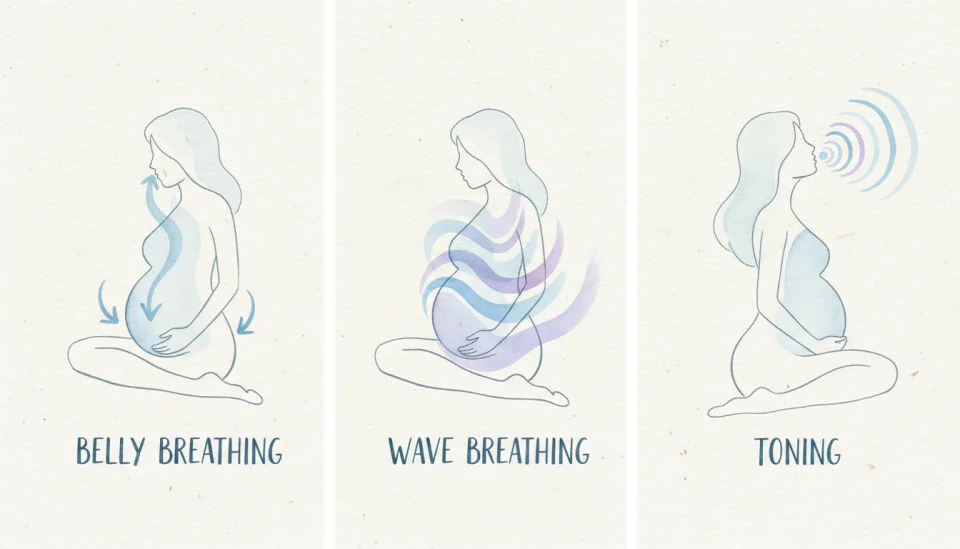
- Slow abdominal breathing: Inhale deeply through your nose, let your belly rise, and exhale slowly through your mouth.
- Wave breathing: Imagine your breath flowing through your body like a wave – from your shoulders to your pelvic floor.
- Toning: Hum a deep “Ahhh” or “Ohhh” while exhaling – this loosens the jaw and relaxes the entire body.
2. Water Birth and Warm Baths
A warm bath at the beginning of labor can alleviate initial contraction pains, as the warm water has a relaxing effect on the muscles. Water births are also a natural method of pain relief. The water supports your weight, allows free movement, and acts like a gentle embrace.
Many birthing centers and clinics offer birthing tubs. Ask your midwife about this option – often, just taking a warm bath during the early phase is enough to help you relax and gather strength.
3. Massage and Touch
Massage is one of the most effective natural methods for pain relief during childbirth. Women who were massaged during labor reported lower levels of pain and less anxiety. Your partner, doula, or midwife can help relieve tension through gentle touch and make you feel less alone.
- Back massage: Circular movements in the lower back relieve back pains during contractions.
- Shoulder pressure: Gentle pressure on the shoulders helps release tension.
- Hand massage: Soothes and provides support during intense moments.
4. Movement and Position Changes
Movement is worth its weight in gold during labor. By changing positions, you can distribute the pressure across different areas of your body, utilize gravity, and help your baby turn optimally into the pelvis.
- Walking, rocking on the birth ball, being on all fours, squatting, or lying on your side – try out what feels good.
- Let your body guide you – it intuitively knows what it needs.

5. HypnoBirthing and Visualization
Self-hypnosis during labor has been shown in many studies to be a effective means against labor pain. HypnoBirthing courses teach breathing techniques and mental exercises for a fear-free and pain-reduced birth. You learn to enter a deep state of relaxation and use positive inner imagery.
Visualization exercise: Imagine your cervix opening like a flower with each contraction, how your baby gently slides down, how you are carried in a warm, safe wave. These images can significantly reduce your perception of pain.
6. Acupuncture and Acupressure
Acupuncture works by stimulating body points to produce a relaxing and pain-relieving effect. It can be applied before labor to soften the cervix and during labor to shorten labor time and relieve pain.
Acupressure, which you or your partner can apply, is also helpful. The point between the thumb and index finger (Large Intestine 4) is known for promoting contractions and reducing pain.
7. Aromatherapy with Essential Oils
The use of essential oils in relaxation baths or through aroma lamps can naturally alleviate contraction pains. Lavender has a calming and anxiety-reducing effect, Bergamot boosts mood, and Jasmine can promote contractions.
Important: Only use high-quality, pure oils and clarify the application with your midwife beforehand. Some oils are not suitable during pregnancy.

8. TENS Device (Transcutaneous Electrical Nerve Stimulation)
A TENS device sends gentle electrical impulses through electrodes on your back and can block pain signals and promote the release of endorphins. Many women use it during the early stages of labor and find it helpful and non-invasive.
You can rent or purchase a TENS device and use it at home or in the birthing center. It gives you control as you can regulate the intensity yourself.
9. Birthing Preparation Courses and Emotional Preparation
A birthing preparation course helps address fears and learn techniques. Support from a partner or trusted individuals can contribute to relaxation through affection and massage. When you understand what happens in your body during childbirth, you lose the fear of the unknown.
Use the course to ask questions, share experiences, and build a network. The feeling of not being alone is invaluable.
10. Trusted Birth Support – Doula, Partner, Midwife
The continuous support of a familiar person – whether it’s your partner, a doula, or your midwife – has proven positive effects on the course of labor. You feel safe, held, and understood. This emotional support reduces stress, promotes relaxation, and can significantly lower the perception of pain.
A doula is specifically trained to provide you with emotional and physical support without performing medical interventions. She is your advocate and companion – a valuable addition to the medical team.

Mental Preparation: Discovering Your Inner Strength
Labor begins in the mind. Fear worsens pain because it tenses your body and releases stress hormones. In contrast, trust and relaxation promote the release of oxytocin – the hormone of birth – and endorphins.
Practice relaxation techniques daily in the weeks leading up to your birth: meditation, progressive muscle relaxation, yoga, or simply quiet breathing. Talk to your baby, tell them that you will get through this together. This connection strengthens you and gives you power.
Experiences of Mothers: “I Didn’t Think I Could Do This”
Sarah, 32, shares: “I was panic-stricken about the pain. But in my birthing preparation class, I learned breathing techniques and visualization. During labor, I focused on my breathing, my partner massaged my back, and I was in the birthing tub. It was intense, but I felt strong and connected. I didn’t think I could do this – but I could.”
Midwife Anna adds: “Women who prepare well and use natural methods often experience labor as self-determined and powerful. They trust their bodies – and that makes the biggest difference.”
Your Path to a Self-Determined Birth
The fear of labor pain is normal and understandable. But you are not helpless. With the right techniques, good preparation, and familiar support, you can make childbirth a powerful, positive experience. Your body is wise, your baby is your partner, and you have more strength within you than you realize.
Try out different methods, find out what feels right for you, and trust that you can walk this path. You can do it – one contraction at a time.
Article translated from German → View original article
Sources & Research
Research Summary
Schwangere Frauen können Geburtsschmerzen mit verschiedenen natürlichen Methoden effektiv lindern. Dazu gehören Atem- und Entspannungstechniken, Wassergeburten, Massagen, Akupunktur, Aromatherapie sowie mentale Vorbereitung wie Hypnose und Visualisierungsübungen. Gespräche über Ängste in Geburtsvorbereitungskursen und Erfahrungsberichte von Müttern und Hebammen unterstützen zusätzlich die emotionale Vorbereitung.
Sources Used
- Schmerzlinderung bei Geburt - Vivantes (Accessed on 2025-11-07)
- Natürliche Schmerzmittel für die Geburt - Keleya (Accessed on 2025-11-07)
- Geburt ohne PDA: Welche Alternativen mit und ohne Medikamente - HypnoBirthing Schweiz (Accessed on 2025-11-07)
- Schmerztherapie rund um die Entbindung - Deutsche Schmerzgesellschaft (Accessed on 2025-11-07)
- Schmerzlinderung (Accessed on 2025-11-07)
- Natürliche Schmerzmittel für die Geburt (Accessed on 2025-11-07)
- 7 Tipps, um die Geburt natürlich einzuleiten (Accessed on 2025-11-07)
- Schmerzlinderung - familienplanung.de (Accessed on 2025-11-07)
- Geburt ohne PDA: Welche Alternativen mit und ... (Accessed on 2025-11-07)
- Schmerztherapie rund um die Entbindung (Accessed on 2025-11-07)
- Schmerzlinderung bei der Geburt (Accessed on 2025-11-07)
- Natürliche Methoden gegen den Wehenschmerz (Accessed on 2025-11-07)
- Schmerzlinderung bei Wehen und Entbindung (Accessed on 2025-11-07)
- Alternative Methoden zur Schmerzlinderung (Accessed on 2025-11-07)
Medical Disclaimer
The information provided in this article is for educational purposes only and is not intended as a substitute for professional medical advice, diagnosis, or treatment. Always seek the advice of your physician or other qualified health provider with any questions you may have regarding a medical condition. Never disregard professional medical advice or delay in seeking it because of something you have read on this website.
Similar Posts
Mindfulness in Pregnancy: 12 Gentle Exercises to Accompany You Through All Phases
Pregnancy is a time of changes, anticipation, and sometimes uncertainty. Mindfulness exercises help you arrive in each p...
Overwhelmed as a Mother? These 5 Immediate Actions Will Help You Now – and in the Long Run
You are not alone: Overwhelm is part of motherhood. Here you will find concrete immediate help for acute moments, proven...
10 Natural Ways to Gently Alleviate Labor Pain – Without Fear
The fear of labor pain is completely normal – but you are not helpless against it. Discover 10 natural, science-based me...
Understanding Panic Attacks in Pregnancy: When Your Heart Races and Hormones Go Haywire
Suddenly your heart races, you feel short of breath, and fear overwhelms you. Panic attacks during pregnancy can be terr...