You sit on the floor, trying to stretch – and suddenly, your toddler climbs onto your back. Instead of relaxation: giggles, chaos, and you wonder if yoga with a child is even possible. The good news: Yes, it is, and it can even be beautiful. With the right poses, your living room can turn into an oasis of strength – playful, brief, and just right for both of you.

Why Yoga with a Toddler is Just Right for You
As a mom of a toddler, there’s little time left for yourself. Between diapers, playgrounds, and naps, an hour-long yoga class seems utopian. But here lies the magic: Yoga at home with your child requires neither much time nor expensive equipment – just a mat or a soft floor.
Short, playful sessions of about 10 minutes are ideal for toddlers. They fit perfectly into daily life and neither overwhelm you nor your child. At the same time, you benefit enormously: The exercises strengthen your body awareness, support postpartum recovery, and provide you with strength, grounding, and stability – exactly what you need after giving birth.
Even better: Your shared practice strengthens your bond. Yoga teaches mindful, loving interactions. Your child learns through mimicry, and you show them how important self-care is. Win-win!
The 4 Best Yoga Poses for Moms with Toddlers
These poses are gentle, effective, and can be wonderfully integrated into everyday life. They strengthen your body, calm your mind, and make it fun for your toddler. Don’t be discouraged if your child crawls away or climbs on you in the middle – that’s part of it!
1. Downward-Facing Dog (Adho Mukha Svanasana)
This classic pose stretches your whole body, strengthens your arms and shoulders, and brings fresh energy. For your toddler, it becomes a tunnel attraction: Many children love crawling under mom!
- How to do it: Start on all fours, press your hands firmly into the ground, and push your hips up and back. Your legs are straight (or slightly bent if that feels better), and your back is long.
- Breathing: Inhale deeply and exhale, holding the position for 5–8 breaths.
- With child: Encourage your toddler to crawl under you – it becomes a game and keeps them engaged.

2. Cat-Cow (Marjaryasana-Bitilasana)
This fluid movement mobilizes your spine, relieves tension in your back, and gently massages your internal organs. Perfect after a night with little sleep!
- How to do it: Come into an all-fours position. Inhale, lowering your belly while lifting your head and tailbone (Cow). Exhale, rounding your back and tucking your chin to your chest (Cat).
- Breathing: Repeat this transition 8–10 times in sync with your breath.
- With child: Your toddler can 'ride' on your back – that’s fun and gives you gentle extra weight for strengthening.
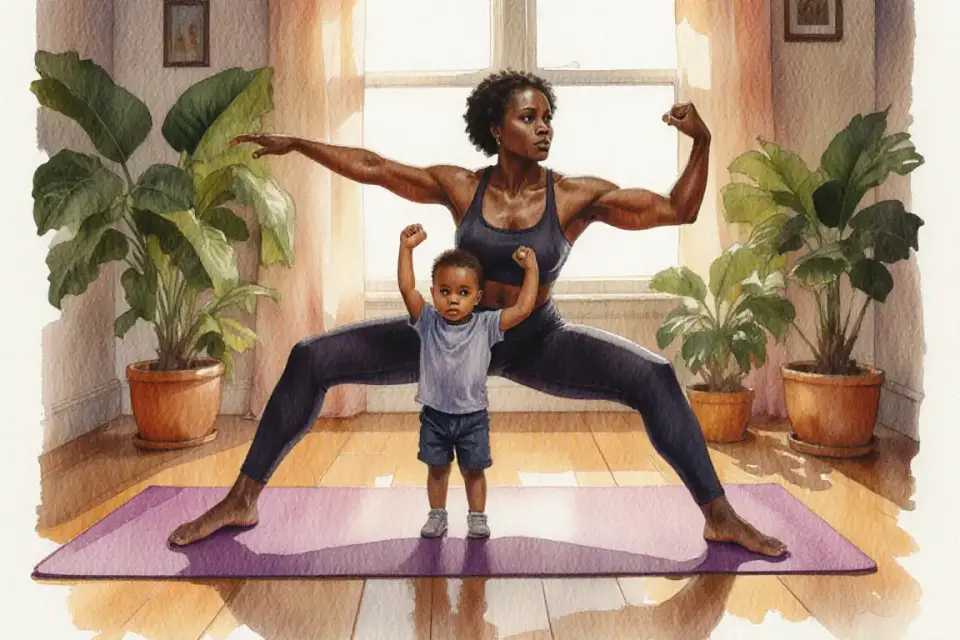
3. Warrior II (Virabhadrasana II)
This powerful standing pose strengthens your legs, hips, and core. It grounds you and gives you a sense of inner strength – exactly what moms need.
- How to do it: Stand with your legs wide apart. Turn your right foot out, bend your right knee (over the ankle). Stretch your arms out to the sides, looking over your right hand.
- Breathing: Hold for 5–8 breaths, then switch sides.
- With child: Let your toddler stand in front of you and 'fly' – stretch your arms out and tell a story about the strong warrior.
4. Child's Pose (Balasana)
The ultimate relaxation pose. It calms the nervous system, gently stretches the lower back, and gives you a moment of peace – even when your child is playing beside you.
- How to do it: Kneel down, sit on your heels, place your forehead on the ground, and stretch your arms forward or rest them relaxed beside your body.
- Breathing: Breathe deeply into your back, holding as long as it feels good (at least 1 minute).
- With child: Your toddler can snuggle beside you or sit gently on your back – this gives you a comforting deep relaxation.

How to Playfully Integrate Yoga into Your Daily Life
The key to success lies in lightness. Forget about perfection – if your child runs away in the middle of a pose or climbs on you, that’s completely okay. Here are a few tips for a relaxed experience:
- Choose the right moment: Right after waking up or before nap time are often good times.
- Make it a ritual: Always at the same time, with the same music or a little 'yoga song' – kids love routine.
- Be flexible: If your child isn't interested, do the poses alone while they play. You are still a role model.
- Use imagination: Name the poses in a child-friendly way ('Dog', 'Cat', 'Warrior') and invent little stories around them.
- Celebrate small victories: Even 5 minutes are valuable. Every movement counts!

Frequently Asked Questions About Yoga with Toddlers
Many moms have similar concerns when starting yoga. Here are the answers to the most important questions:
- Do I need previous yoga experience? No! These poses are beginner-friendly. Listen to your body and do only what feels good.
- What if my child won’t join in? No problem. Let them play and do your exercises anyway. Kids often watch and may join in themselves later.
- How often should I practice? Even 2–3 times a week for 10 minutes makes a difference. Quality over quantity!
- Do I need special equipment? No. A yoga mat is nice, but a carpet or a soft blanket works too.
- Can I practice with a baby too? Yes! Many poses work with infants. Just adapt them (e.g., lay the baby in front of you in child’s pose).
Your 10 Minutes for More Strength and Calm
Yoga with a toddler is not a perfect Instagram photo – it's real, chaotic, and beautiful all at once. These 4 poses give you new energy, strengthen your body, and deepen your bond with your child in just 10 minutes. You don’t need expensive equipment, a studio, or an hour of time.
Start today: Roll out your mat, invite your toddler, and enjoy these precious moments. Your body will thank you, your mind will be calmer – and your child will learn along the way how important self-care is.
You are enough. You can do this. And these 10 minutes are yours.
Article translated from German → View original article
Sources & Research
Research Summary
Yoga mit Kleinkindern stärkt die Bindung, fördert Entspannung und bringt spielerische Bewegung in den Alltag. Die Übungen sind einfach umzusetzen, erfordern keine Vorkenntnisse und lassen sich flexibel an das Alter und die Bedürfnisse des Kindes anpassen.
Sources Used
- Mutter-Kind-Yoga: Übungen & Tipps für Eltern und Kind (Accessed on 2025-11-03)
- 5 Yogaübungen für Mama & Baby (Accessed on 2025-11-03)
- Mutter-Kind-Yoga: Übungen & Tipps für Eltern und Kind (Accessed on 2025-11-03)
- Yoga mit Baby | Mutter Kind Yoga | Asanas für Mamas (Accessed on 2025-11-03)
- 5 Yogaübungen für Mama & Baby (Accessed on 2025-11-03)
- Kinder-Yoga: Übungen für Mutter und Kind - yogaworld.de (Accessed on 2025-11-03)
- Eltern-Kind-Yoga: Asanas für dein Kind und dich (Accessed on 2025-11-03)
- Yoga für Mütter und Babys (Accessed on 2025-11-03)
- Yoga für Mütter: Übungen mit Baby (Accessed on 2025-11-03)
- Yoga mit Baby (Accessed on 2025-11-03)
Medical Disclaimer
The information provided in this article is for educational purposes only and is not intended as a substitute for professional medical advice, diagnosis, or treatment. Always seek the advice of your physician or other qualified health provider with any questions you may have regarding a medical condition. Never disregard professional medical advice or delay in seeking it because of something you have read on this website.
Similar Posts
10 Natural Methods to Combat Labor Pain – That Really Empower You
The fear of labor pain accompanies many expectant mothers. However, there are effective, natural ways to alleviate pain ...
Mindfulness in Pregnancy: 12 Gentle Exercises to Accompany You Through All Phases
Pregnancy is a time of changes, anticipation, and sometimes uncertainty. Mindfulness exercises help you arrive in each p...
Overwhelmed as a Mother? These 5 Immediate Actions Will Help You Now – and in the Long Run
You are not alone: Overwhelm is part of motherhood. Here you will find concrete immediate help for acute moments, proven...
10 Natural Ways to Gently Alleviate Labor Pain – Without Fear
The fear of labor pain is completely normal – but you are not helpless against it. Discover 10 natural, science-based me...