
You hold your newborn baby in your arms, and everyone expects you to be overjoyed. But instead of joy, you feel a heavy emptiness, exhaustion, and a sense of being completely overwhelmed. You are not alone - about 8 to 10 percent of all fathers experience postpartum depression after the birth of their child. It's time to talk about it.

What is Postpartum Depression in Fathers - and Why is it Often Overlooked?
Postpartum depression (PPD) is typically associated with mothers. However, fathers can also enter a deep emotional crisis after the birth of their child. The symptoms are similar to those in women: depressed mood, loss of interest, withdrawal, sleep disturbances, irritability, and in severe cases, even thoughts of suicide. The difference? Men often express their despair differently - through anger, irritability or excessive work.
The problem: The number of unreported cases is extremely high. Many fathers refrain from seeking help out of shame or fear of rejection. They believe they have to be “strong” or “functioning”. Yet, PPD in fathers is not a sign of weakness, but a serious mental health condition that can and should be treated.
Why are Fathers Especially at Risk?
Several factors increase the risk of paternal postpartum depression:
- Hormonal changes: Even in men, testosterone levels drop after birth, while prolactin and cortisol levels rise - which can affect mood.
- Sleep deprivation and stress: The first months with a baby are exhausting for all parents.
- Changing partnership: Relationships are under pressure, intimacy and shared time are often lacking.
- Financial worries: The pressure to provide for the family can be overwhelming.
- Partner’s PPD: If the partner suffers from postpartum depression, the risk for the father increases to as much as 50 percent.
Recognizing the Signs: How Postpartum Depression Manifests in Fathers
The symptoms can be subtle and are often dismissed as “normal” adjustment difficulties. However, if several of the following signs persist for two weeks or longer, you should pay attention:

- Persistent sadness or emotional numbness
- Loss of interest in activities that used to bring you joy
- Withdrawal from family, friends, or social activities
- Sleep issues - even when the baby sleeps
- Extreme fatigue and loss of energy
- Irritability, anger, or aggression - often the “male” variant of depression
- Difficulty concentrating and making decisions
- Feelings of worthlessness or excessive guilt (“I’m not a good father”)
- Physical complaints like headaches or stomachaches with no clear cause
- Thoughts of self-harm or the desire to “just disappear”
Important: This depression has nothing to do with character weakness. It is a treatable condition triggered by biological, psychological, and social factors.
Finding Help: Resources and Support for Affected Fathers
The first step is the hardest: admitting that something is wrong. Yet this step is the most important. Here you will find concrete contacts and strategies:
Professional Help
- General practitioner: A good first contact for an initial assessment and referral
- Psychotherapy: Cognitive behavioral therapy or talk therapy has proven effective for PPD
- Psychiatrist: For moderate to severe depression, medication treatment may be beneficial
- Father counseling: Specialized counseling services for fathers in Switzerland (e.g., männer.ch, Väterbüro)
- Telephone crisis intervention: Die Dargebotene Hand (Tel. 143) is available around the clock
Self-Help and Daily Strategies
- Talk about it: With your partner, a friend, your brother - whoever is close to you
- Establish routines: Regular sleep times (as much as possible), healthy eating, short walks
- Take small breaks: 15 minutes a day just for yourself - exercise, music, a book
- Set realistic expectations: You do not have to be the perfect father. Good enough is good enough.
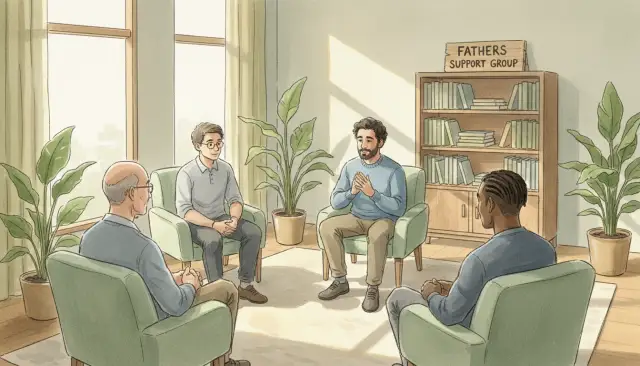
- Father groups: Sharing experiences with other fathers can be immensely relieving
Real Voices: Fathers Who Have Found Their Way Out of Depression
Marco, 34: “I thought I just had to endure it. But after three months, I couldn’t take it anymore. I was irritable, yelled at my wife, and didn’t want to hold the baby. My wife urged me to see a doctor. Therapy helped me understand that I hadn’t failed - my brain was simply out of balance.”
Stefan, 29: “When my partner had her own postpartum depression, I felt completely helpless. I wanted to be strong, but I broke down. A friend told me about his own experience, and that gave me the courage to seek help. Today, we are both better, and we have learned to talk openly about our feelings.”

David, 41: “I threw myself into work to avoid being home. I was ashamed because I thought a real man has to endure that. It was only when my boss addressed my performance issues that I realized I needed professional help. The medication and therapy have given me my life back.”
Communication is Key: Tips for Fathers and Their Families
Open communication can save lives - literally. Here are concrete strategies on how to lead the conversation:
For Affected Fathers
- Choose the right moment: Not in passing, but when both partners have time and peace
- Use “I” statements: “I feel overwhelmed” instead of “You don’t understand me”
- Be concrete: “I’m sleeping poorly, I'm constantly irritable, and I no longer take joy in things that used to be important to me”
- Request specific support: “Can you come with me to the doctor?” or “I need an hour a day for myself”
- Explain that it is not a blame game: It’s not about something the partner did wrong
For Partners and Family
- Listen without judging: Avoid phrases like “Pull yourself together” or “Others manage it too”
- Take changes seriously: If your partner withdraws or is unusually irritable, address it
- Offer specific help: “Should I schedule a doctor’s appointment for you?”
- Remind him of his strengths: “You are a good father, even if it doesn’t feel that way right now”
- Seek support together: Couple therapy can help tackle the crisis together

The Way Forward: Why It's Worth Seeking Help
Postpartum depression in fathers is not just a personal problem - it affects the whole family. Studies show that paternal depression can negatively influence children's emotional development, especially if the mother is also affected. Children need emotionally available parents, and you can only be that if you are well.
The good news: Postpartum depression is treatable. With the right support - whether through therapy, medication, support groups, or a combination thereof - most fathers find their way back to themselves and to their families.
You are not a bad father for needing help. On the contrary: You are a responsible father because you recognize that something is wrong and have the courage to do something about it. Your child doesn't need a perfect father - it needs a father who takes care of himself so that he can be there for his child.
If you see yourself in this article, do not hesitate: Talk to someone. Today. Now. You deserve to experience this time with your child in joy - not in the shadow of depression.
Article translated from German → View original article
Sources & Research
Research Summary
Postpartale Depressionen betreffen nicht nur Mütter, sondern auch Väter – bis zu 10 Prozent der Väter leiden nach der Geburt ihres Kindes darunter. Die Symptome ähneln denen bei Frauen, werden aber oft übersehen, da sie schleichend auftreten und Männer ihre Gefühle häufig verbergen.
Sources Used
- Papa kann nicht mehr – Postpartale Depression bei Vätern (Accessed on 2025-11-07)
- Wochenbettdepression beim Mann: Wie macht es sich bemerkbar? (Accessed on 2025-11-07)
- Auch Väter haben Baby Blues (Accessed on 2025-11-07)
- DRKS - Deutsches Register Klinischer Studien (Accessed on 2025-11-07)
- Depression nach der Geburt kann auch Väter treffen (Accessed on 2025-11-07)
- Auch Männer haben Angststörungen (Accessed on 2025-11-07)
- Postpartale Depression bei Vätern - Psyche nach der Geburt (Accessed on 2025-11-07)
- Wochenbettdepression: Was ist das? (Accessed on 2025-11-07)
- Vater (32) kämpft nach Geburt mit postnataler Depression (Accessed on 2025-11-07)
Medical Disclaimer
The information provided in this article is for educational purposes only and is not intended as a substitute for professional medical advice, diagnosis, or treatment. Always seek the advice of your physician or other qualified health provider with any questions you may have regarding a medical condition. Never disregard professional medical advice or delay in seeking it because of something you have read on this website.
Similar Posts
10 Natural Methods to Combat Labor Pain – That Really Empower You
The fear of labor pain accompanies many expectant mothers. However, there are effective, natural ways to alleviate pain ...
Mindfulness in Pregnancy: 12 Gentle Exercises to Accompany You Through All Phases
Pregnancy is a time of changes, anticipation, and sometimes uncertainty. Mindfulness exercises help you arrive in each p...
10 Natural Ways to Gently Alleviate Labor Pain – Without Fear
The fear of labor pain is completely normal – but you are not helpless against it. Discover 10 natural, science-based me...
Understanding Panic Attacks in Pregnancy: When Your Heart Races and Hormones Go Haywire
Suddenly your heart races, you feel short of breath, and fear overwhelms you. Panic attacks during pregnancy can be terr...