
You are sitting in the waiting room of your gynecologist, your hands are sweaty, your breath is shallow. Or it’s 3 AM, and worries about giving birth keep you awake. Do you know these moments? The good news: You already carry the most effective calming agent within you – your breath. Box breathing is a simple, safe technique that calms your nervous system in just 2 minutes and gives you back a sense of control.

What is Box Breathing and Why Does it Work So Quickly?
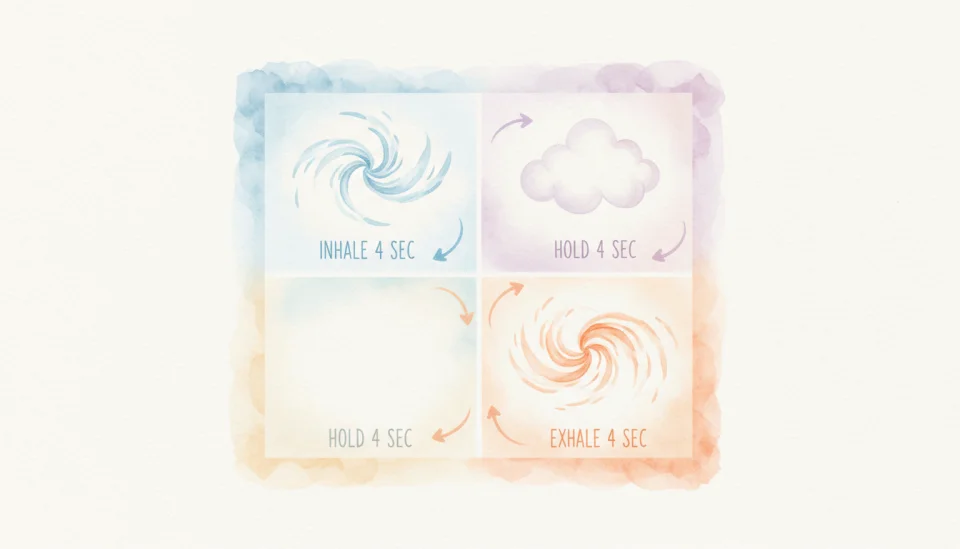
Box breathing – also known as quadratic breathing or the 4-4-4-4 method – is a rhythmic breathing technique consisting of four equal phases: Inhale, Hold, Exhale, Hold. Each phase lasts four seconds, creating a calming square.
The mechanism behind it: When you're stressed, your sympathetic nervous system (the "fight or flight" mode) dominates. By consciously breathing slowly, you activate the parasympathetic nervous system – your "rest and digest" mode. This lowers your heart rate, relaxes your muscles, and signals your brain: "Everything is safe."
Especially valuable for you as a pregnant woman: Box breathing is gentle, requires no physical effort, and can be practiced in any position. It provides you and your baby with oxygen without risking hyperventilation.
Scientifically Proven: Why Breathing Techniques Help During Pregnancy
Studies show that controlled breathing exercises significantly reduce stress and anxiety. Certain breathing techniques from yoga are also useful for breathing better during pregnancy and mentally preparing for childbirth. Box breathing is one of the safest methods because it does not require extreme breath-holding phases or forced exhalation.
Step-by-Step Guide: How to Practice Box Breathing
The technique is incredibly simple – you just need 2 minutes and a quiet moment. Here is your guide:
- Step 1 – Preparation: Sit comfortably (on a chair, a cushion, or in bed). Gently place one hand on your belly and the other on your heart. Close your eyes or lower your gaze.
- Step 2 – Inhale (4 seconds): Breathe slowly and deeply through your nose. Internally count: 1 – 2 – 3 – 4. Feel your belly rise.
- Step 3 – Hold (4 seconds): Gently hold your breath without straining. Count: 1 – 2 – 3 – 4. Stay relaxed.
- Step 4 – Exhale (4 seconds): Slowly breathe out through your nose or mouth. Count: 1 – 2 – 3 – 4. Let go of all tension.
- Step 5 – Hold (4 seconds): Keep your lungs empty without tensing up. Count: 1 – 2 – 3 – 4.
Repeat this cycle 5–8 times (about 2 minutes). You will already notice a change after the second round – your heart rate slows down, your shoulders drop, your mind becomes clearer.
Beginner Variant: The 3-3-3-3 Method
If 4 seconds feels too long (especially in the third trimester when your baby is pressing on your diaphragm), start with the 3-3-3-3 variant. Shorten each phase to 3 seconds. The principle remains the same, but you give your body more room to adjust.
As soon as you feel more comfortable, you can gradually increase to 4 seconds. There is no right or wrong – only what feels right for you.

When and Where You Can Apply Box Breathing
The beauty of this technique lies in its flexibility. You don’t need any special equipment, no yoga class, no app. Here are specific situations where box breathing can support you:
At Prenatal Appointments
Nervousness can arise before or during ultrasounds, blood tests, or meetings with the midwife. Use the waiting time: Sit up straight, close your eyes, and breathe for 2 minutes in the box rhythm. You will enter the appointment calmer and can absorb information better.
Before Bedtime
Racing thoughts, back pain, frequent awakenings – sleep issues are common during pregnancy. Ritual for Better Sleep: Lie on your left side (optimal for blood circulation), support your belly with a pillow, and practice 5–10 rounds of box breathing. The rhythmic breathing signals your body that it’s time to wind down.
Other Use Cases
- For Nausea: Slow, conscious breathing can alleviate nausea (combine with fresh air).
- For Labor Thoughts: When fears about childbirth arise, box breathing grounds you in the here and now.
- In Everyday Life: Before important conversations, after stressful moments, or simply as a daily self-care ritual.

Your 2-Minute Routine: How to Incorporate Box Breathing into Your Daily Life
Regularity is key. Here’s a simple routine you can implement immediately:
- In the Morning: 2 minutes of box breathing right after waking up (still in bed or with your first coffee/tea). Start your day with calmness.
- At Noon: Short break after a meal or before an important meeting. Hit the reset button.
- In the Evening: 5–10 minutes before bedtime. Prepares body and mind for recovery.
Tip: Set a timer on your phone (e.g., every 4 hours) with the reminder "Breathe." This way, you won’t forget, even on hectic days.
Downloadable Reminders and Timer Apps
If you like visual support, create a small reminder card: Draw a square, label the sides with "Inhale – Hold – Exhale – Hold" and hang it on your bathroom mirror or refrigerator. Alternatively, use timer apps specifically designed for breathing exercises (many offer visual animations of a square expanding and contracting).

Frequently Asked Questions About Box Breathing During Pregnancy
Here we answer the key questions many expectant mothers have:
- Is box breathing safe for my baby? Yes, absolutely. The gentle breath-holding phases are short enough that they do not affect oxygen supply. On the contrary: Less stress for you means less stress hormones for your baby.
- What if I feel like I’m not getting enough air? Shorten the phases to 3 seconds or skip the hold phases initially. Just breathe in for 4 seconds, out for 4 seconds. Your body will show you what it needs.
- Can I use box breathing during contractions? Many women find rhythmic breathing helpful during early labor. Talk to your midwife about adapted breathing techniques for the active birth phase.
- How quickly does box breathing work? Often, you’ll already notice a change after 2–3 cycles (30–45 seconds). After 2 minutes, the effect is measurable (heart rate, muscle tone).
- Do I have to close my eyes? No, that’s optional. Some find it easier to concentrate with closed eyes, while others prefer a soft gaze at a fixed point.
Your First Step: Try It Now
You now have everything you need. Take exactly 2 minutes right now. Sit comfortably, place one hand on your belly, and breathe with me: Inhale 1-2-3-4, Hold 1-2-3-4, Exhale 1-2-3-4, Hold 1-2-3-4. Repeat this five times.
How do you feel? Probably a little calmer, a little more centered. This is the power of your breath. This technique now belongs to you – in waiting rooms, sleepless nights, moments of overwhelm. You always carry your calm with you.
Take a deep breath. You can do it. One breath at a time.
Article translated from German → View original article
Sources & Research
Research Summary
Die Boxatmung ist eine schnelle und effektive Atemtechnik, die Schwangeren helfen kann, Stress und Angstzustände zu bewältigen. Mit einer einfachen 4-4-4-4-Methode lässt sie sich leicht erlernen und in Alltagssituationen wie pränatalen Terminen oder vor dem Schlafengehen anwenden.
Sources Used
- Übungen: Richtig atmen in der Schwangerschaft (Accessed on 2023-09-15)
- Atemübungen Schwangerschaft: Entspannung für die ... (Accessed on 2023-09-15)
- Boxatmung (Accessed on 2023-09-15)
- Box-Atmung: Ein Leitfaden zur Entspannung (Accessed on 2023-09-15)
- Atemübung für Schwangerschaft, Geburt und Rückbildung (Accessed on 2025-11-04)
- 3 Atemübungen für Schwangere (Accessed on 2025-11-04)
- Entspannung in der Schwangerschaft (Accessed on 2025-11-04)
- Die tiefe Bauchatmung (Accessed on 2025-11-04)
- 3 Atemübungen für die Geburt (Accessed on 2025-11-04)
Medical Disclaimer
The information provided in this article is for educational purposes only and is not intended as a substitute for professional medical advice, diagnosis, or treatment. Always seek the advice of your physician or other qualified health provider with any questions you may have regarding a medical condition. Never disregard professional medical advice or delay in seeking it because of something you have read on this website.
Similar Posts
10 Natural Methods to Combat Labor Pain – That Really Empower You
The fear of labor pain accompanies many expectant mothers. However, there are effective, natural ways to alleviate pain ...
Mindfulness in Pregnancy: 12 Gentle Exercises to Accompany You Through All Phases
Pregnancy is a time of changes, anticipation, and sometimes uncertainty. Mindfulness exercises help you arrive in each p...
10 Natural Ways to Gently Alleviate Labor Pain – Without Fear
The fear of labor pain is completely normal – but you are not helpless against it. Discover 10 natural, science-based me...
Understanding Panic Attacks in Pregnancy: When Your Heart Races and Hormones Go Haywire
Suddenly your heart races, you feel short of breath, and fear overwhelms you. Panic attacks during pregnancy can be terr...