
You’re sitting on the sofa, your baby peacefully sleeping in your arms – and suddenly the tears start to flow. Without any apparent reason, you feel overwhelmed, exhausted, and not quite like yourself. Are you just tired, or is this something serious? Countless new mothers ask themselves this question. The good news: You are not alone, and there are clear indicators that can help you categorize your feelings.

What Exactly are the Baby Blues – and Why Do So Many Experience Them?
The baby blues are actually surprisingly common: About 70–80% of all new mothers experience it in the first few days after childbirth. This means you’re in good company if you currently feel emotionally like you’re on a rollercoaster.
The symptoms are usually mild to moderate and include:
- Weeping without a recognizable reason – sometimes simply because an advertisement was touching
- Mood swings between elation and sadness
- Tiredness and exhaustion (even when the baby is sleeping)
- Restlessness, mild anxiety, or irritability
- Difficulties concentrating
- Sleep problems, even when the opportunity is there
Why does this happen? After childbirth, your hormones literally plummet – estrogen and progesterone drop sharply. At the same time, you are physically exhausted, your sleep rhythm is in chaos, and you have to adjust to a completely new reality of life. No wonder your emotional life is doing somersaults!
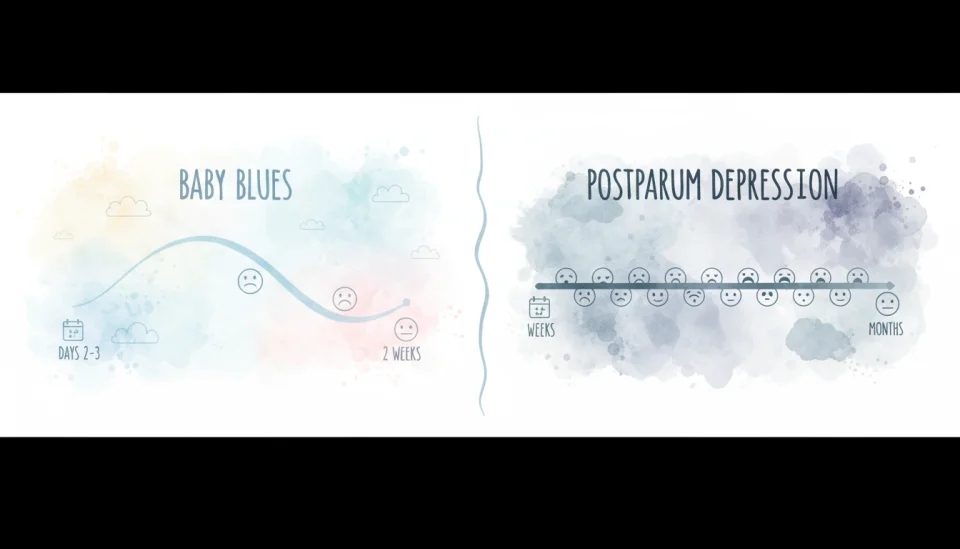
The crucial point: The baby blues usually begin 2–3 days after birth and improve on their own within a few weeks. You don’t need special treatment – just patience, rest, and support.

Postpartum Depression: When the Dark Cloud Remains
Postpartum depression (PPD) is something entirely different. It affects about 10% of mothers and is significantly more severe. While the baby blues pass like a brief storm, postpartum depression is more like a stubborn fog that can linger for weeks, months, or even years.
The symptoms are more intense and longer-lasting
With postpartum depression, you don't just experience occasional tears, but rather deep, persistent sadness. The symptoms may include:
- Extreme low mood that doesn’t fade
- A feeling of emptiness or hopelessness
- Intense anxiety, panic attacks, or overwhelming worries
- Feelings of guilt or the sense of failure as a mother
- Difficulties bonding with the baby
- Withdrawal from partner, family, and friends
- Thoughts of harming yourself or the baby (even if you would never do that)
- Loss of appetite or overeating
- Inability to feel joy – even in things that were important to you before
These symptoms are not your fault. They arise from a combination of hormonal changes, genetic predisposition, sleep deprivation, and the tremendous demands of the new role as a mother.
The key difference: Duration and Intensity
Here’s the most important rule of thumb: If your symptoms last longer than two weeks or worsen instead of improving, it could be postpartum depression. Unlike baby blues, PPD does not disappear on its own – it requires professional help.
When Should You Definitely Seek Help?
It’s not always easy to recognize when normal adjustment difficulties turn into something that needs professional support. Here are clear warning signs that you should take action:
- Your symptoms last longer than two weeks
- You feel worse and worse instead of better
- You have difficulties caring for your baby or completing daily tasks
- You have thoughts of harming yourself or your baby
- You are completely withdrawing and avoiding social contacts
- You can hardly sleep, even when the baby sleeps
- You experience panic attacks or overwhelming feelings of fear
- Your partner or family are seriously worried about you
Important: You don’t need to have all these symptoms to deserve help. Even if you simply don’t feel like yourself and have a sense that something is wrong, you should seek support.
Talk to your midwife, your gynecologist, or reach out to a mental health counseling center. In Switzerland, there are also mother and father counseling services as well as specialized points of contact for perinatal mental illnesses.
Self-Reflection Checklist: Where Am I Right Now?
Sometimes it helps to see your feelings in black and white. Take a quiet moment and honestly go through these questions:
- How long have I been feeling this way? (Less than 2 weeks / Longer than 2 weeks)
- Are my symptoms getting better, staying the same, or worsening?
- Can I still find joy in small things?
- Do I feel connected to my baby, or do they feel foreign to me?
- Am I able to take basic self-care (eat, shower, sleep)?
- Is there someone I can openly talk to about my feelings?
- Do I have thoughts that scare me?
- Do I feel hopeless or empty most of the time?
If you answer “Yes, that’s true” or “Longer than 2 weeks” to several points, it’s time to seek professional help. This is not a sign of weakness – it is a sign of strength and self-care.

How Partners and Family Can Really Help
If you are personally affected, feel free to share this section with your partner or family. If you want to support someone, here are specific ways you can help:
Provide Emotional Support
- Listen without judgment: Sometimes she just needs someone to be there – without advice or solutions
- Validate instead of minimizing: Phrases like “This will pass” or “Others have it worse” are unhelpful. Better: “I see that you’re struggling right now. That’s okay.”
- Regularly check in: A simple “How are you really doing?” can open doors
Practical Help in Daily Life
- Take on specific tasks: Cooking, shopping, washing clothes
- Give her some breaks – even if it’s just 30 minutes for a shower or a walk
- Take on night shifts so she can get some sleep
- Organize help from outside (cleaners, food deliveries, family members)
Encourage Professional Help
If you’re worried, gently bring it up: “I’m concerned about you. Maybe it would help to talk to someone who knows about this?” Offer to help make an appointment or accompany her.
Important for partners: Therapy should ideally also strengthen the mother-child relationship and involve you as a partner. Together, you are stronger.

You Deserve Support – and Healing is Possible
Whether it’s baby blues or postpartum depression: Your feelings are real and important. The baby blues usually go away on their own, but they also deserve recognition and gentle self-care. Postpartum depression, on the other hand, requires professional help – but it is absolutely treatable.
With the right support – whether through psychotherapy, medication, support groups, or a combination thereof – most mothers find their way back to themselves. You are not a bad mother for having these feelings. You are a brave mother facing your reality.
Take the time you need. Seek the help you deserve. And remember: It gets better. You are not alone on this journey.
Article translated from German → View original article
Sources & Research
Research Summary
Baby Blues sind vorübergehende Stimmungsschwankungen, die nach der Geburt bei vielen Müttern auftreten und meist nach einigen Tagen bis zwei Wochen von selbst abklingen. Die postpartale Depression ist eine ernstzunehmende psychische Erkrankung, die länger anhält, schwerere Symptome verursacht und medizinische Unterstützung erfordert.
Sources Used
- Baby Blues vs. Postpartum Depression: Key Differences (Accessed on 2025-11-07)
- Is It the “Baby Blues” or Postpartum Depression? (Accessed on 2025-11-07)
- Postpartum depression or baby blues? (Accessed on 2025-11-07)
- Baby Blues vs. Postpartum Depression | South Dakota (Accessed on 2025-11-07)
- Differences Between Postpartum Depression and “Baby Blues” (Accessed on 2025-11-07)
- 3 differences between baby blues and postnatal depression (Accessed on 2025-11-07)
- Baby Blues or Post-Partum Depression: What's the Difference (Accessed on 2025-11-07)
Medical Disclaimer
The information provided in this article is for educational purposes only and is not intended as a substitute for professional medical advice, diagnosis, or treatment. Always seek the advice of your physician or other qualified health provider with any questions you may have regarding a medical condition. Never disregard professional medical advice or delay in seeking it because of something you have read on this website.
Similar Posts
10 Natural Methods to Combat Labor Pain – That Really Empower You
The fear of labor pain accompanies many expectant mothers. However, there are effective, natural ways to alleviate pain ...
Mindfulness in Pregnancy: 12 Gentle Exercises to Accompany You Through All Phases
Pregnancy is a time of changes, anticipation, and sometimes uncertainty. Mindfulness exercises help you arrive in each p...
10 Natural Ways to Gently Alleviate Labor Pain – Without Fear
The fear of labor pain is completely normal – but you are not helpless against it. Discover 10 natural, science-based me...
Understanding Panic Attacks in Pregnancy: When Your Heart Races and Hormones Go Haywire
Suddenly your heart races, you feel short of breath, and fear overwhelms you. Panic attacks during pregnancy can be terr...