You stand in front of the mirror in the morning and hear an inner voice commenting on your body – often not very kindly. Perhaps you use words that you would never say out loud, but that are deeply ingrained within you. Words that carry shame. This language was taught to you, often unconsciously, and it influences how you perceive yourself. But here’s the good news: What has been learned can also be unlearned. You can reshape your inner language – and with it, your entire body image.

Where Does Shame Come From – And Why Does It Go So Deep?
Shame surrounding sexuality and one's own body rarely develops overnight. It builds up over years, shaped by upbringing, cultural norms, media, and often by casual remarks we picked up as children or adolescents. Perhaps there were whispers about "down there," certain body parts were never named, or sexual curiosity was met with silence or scolding.
A central result of this sexual shame is that it silences us. We are ashamed to the point that we cannot even talk about our shame. This cycle keeps shame alive and allows it to grow. It nests into our self-image and whispers to us that parts of us are "wrong," "dirty," or "embarrassing."
But shame is not just destructive. When we process it consciously instead of rejecting it, it can be transformative. Instead, we should own our shame and reclaim it. This can lead to self-acceptance and even pride. The first step towards this is recognizing shame and understanding its roots.
Language Shapes Your Body Perception – More Than You Think
The words you use for your body and your sexuality are not neutral. They carry judgments, emotions, and often centuries-old prejudices within them. For example, if you refer to your body as having "problem areas" or label sexual needs as "indecent," you send a clear message to your brain: This is not okay.

Many women do not realize that their own sexuality can be a key factor for their self-confidence as well. The way we talk about our bodies – internally and externally – directly influences how we feel in them. Negative, shame-laden language intensifies insecurity and withdrawal. Neutral or positive language, on the other hand, opens up space for acceptance, curiosity, and self-love.
Those who are ashamed of their bodies or deny their sexual desires pull back emotionally. Shame blocks closeness and emotional connection – with yourself and with others. Through open conversations and conscious word choices, the burden of guilt lifts, and genuine closeness becomes possible again.
How Language Works in Everyday Life
- Inner Dialogue: The words you use in your thoughts about yourself shape your self-image daily.
- Conversations with Partners: Open communication about fears and insecurities can lead to your partner offering understanding and support, which, in turn, strengthens mutual trust.
- Raising the Next Generation: The language you choose also shapes how children perceive their own bodies.
Neutral and Positive Alternatives: Your Word-for-Word Tool
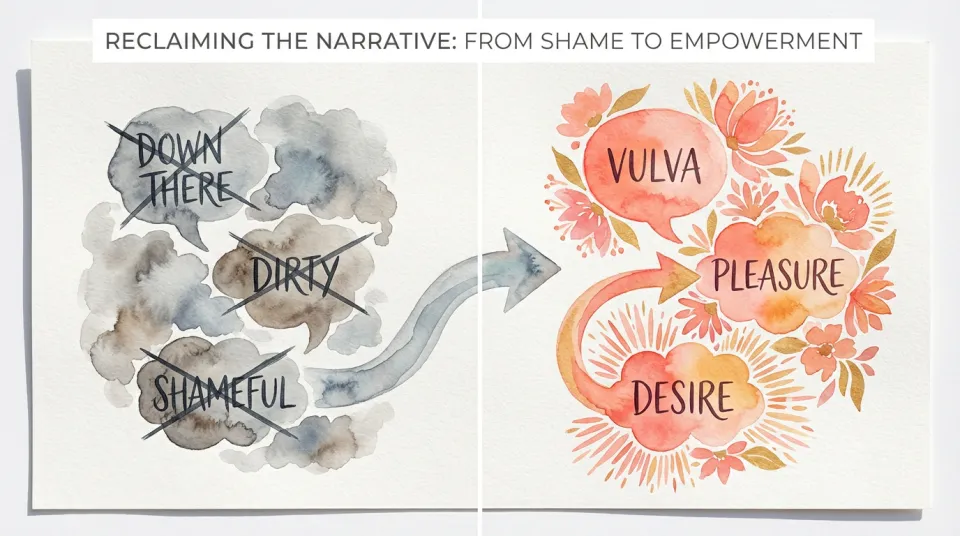
Now it gets practical. Here you will find a list of shame-laden words and phrases – and powerful, neutral or positive alternatives that you can use instead. This shift may feel unfamiliar at first, but over time it will become your new normal.
Body Parts & Anatomy
- Instead of: "down there", "intimate area" (when used evasively) → Better: vulva, vagina, clitoris, labia (or: outer/inner lips)
- Instead of: "problem areas" → Better: my body, my curves, my shape
- Instead of: "embarrassing body functions" → Better: natural body functions, my cycle, my period
Sexuality & Desire
- Instead of: "dirty", "indecent", "sin" → Better: pleasurable, fulfilling, my desire, my curiosity
- Instead of: "I shouldn't..." → Better: I may, I allow myself, I explore
- Instead of: "that's not done" → Better: that's part of my sexuality, that belongs to me
Self-Image & Emotions
- Instead of: "I am ashamed" (without reflection) → Better: I feel shame, and I want to understand where it comes from
- Instead of: "I am wrong" → Better: I am learning to accept myself as I am
- Instead of: "I am too much/too little" → Better: I am enough, I am allowed to have my needs
Regular self-reflection and engaging with your own feelings and thoughts can help develop a deeper self-understanding and acceptance. Take time to consciously notice your inner language – perhaps in a journal or in conversations with trusted people.

How to Integrate the New Language into Your Everyday Life
Change takes practice and patience. Here are concrete steps on how to invite the new, empowering language into your life:
- Create Awareness: For a week, pay attention to the words you use internally and externally for your body and sexuality. Write them down without judgment.
- Gradually Replace: Choose one or two shame-laden words and consciously replace them with positive alternatives. Repeat the new words out loud, write them down.
- Talk to Trusted People: Share your thoughts with a friend, partner, or therapist. Open communication breaks the silence and allows shame to lose its power.
- Use Affirmations: Phrases like "My body deserves respectful words" or "I am allowed to feel pleasure and talk about it" can help pave new neural pathways.
- Be Patient with Yourself: Old patterns don't dissolve overnight. Celebrate small progress and be kind to yourself when you slip back into old speech patterns.

Your Language, Your Freedom
Unlearning shame is an act of self-liberation. The words you choose are tools – they can keep you small or empower you. By consciously cultivating a language that treats your body and sexuality with respect, curiosity, and love, you not only change your self-image but also your relationships and your overall sense of life.
You are not alone on this journey. Many women are rediscovering how powerful it is to reclaim their own language. Start today – with a single word that you choose differently. And watch as space gradually opens up for less shame and more self-acceptance to grow.
Article translated from German → View original article
Sources & Research
Research Summary
Scham rund um Sexualität entsteht oft durch gesellschaftliche Tabus, alte Glaubenssätze und mangelnde offene Kommunikation, die das Selbstwertgefühl und die Körperwahrnehmung negativ beeinflussen. Durch bewusste Spracharbeit, offene Gespräche und Selbstreflexion können Frauen diese Scham transformieren und ein gestärktes Selbstbewusstsein entwickeln. Sprache spielt eine Schlüsselrolle dabei, Scham zu überwinden und echte Nähe sowie Selbstakzeptanz zu ermöglichen.
Sources Used
- Wie Frauen durch Sexualität ihr Selbstbewusstsein stärken können (Accessed on 2026-01-23)
- Scham loslassen: Mehr Nähe, Lust und Selbstvertrauen (Accessed on 2026-01-23)
- Wie Angst und Scham unser Sexleben verderben (Accessed on 2026-01-23)
- Selbstwertgefühl im Sex – Rein&Raus Sex-Podcast (Accessed on 2026-01-23)
- Scham ist auch Power, lasst sie uns nutzen! (Accessed on 2026-01-23)
- Wie Frauen durch Sexualität ihr Selbstbewusstsein stärken ... (Accessed on 2026-01-23)
- Scham loslassen: Mehr Nähe, Lust und Selbstvertrauen (Accessed on 2026-01-23)
- Wie Angst und Scham unser Sexleben verderben (Accessed on 2026-01-23)
- Selbstwertgefühl im Sex – Rein&Raus Sex-Podcast (Accessed on 2026-01-23)
- Scham ist auch Power, lasst sie uns nutzen! (Accessed on 2026-01-23)
- Sexualität - Ohne Klitoris kein Orgasmus (Accessed on 2026-01-23)
Medical Disclaimer
The information provided in this article is for educational purposes only and is not intended as a substitute for professional medical advice, diagnosis, or treatment. Always seek the advice of your physician or other qualified health provider with any questions you may have regarding a medical condition. Never disregard professional medical advice or delay in seeking it because of something you have read on this website.
Similar Posts
Rediscovering Your Desire: The Gentle Restart After a Long Break
After months or years without sex, does everything feel foreign? You are not alone. Learn why breaks are completely norm...
Medications Dampen Your Desire? What You Need to Know Now
Many medications significantly affect libido and orgasm ability. Here you will learn which substances typically cause pr...
Masturbation in Relationships: How to Talk Openly and Without Jealousy
Masturbation is normal – even in relationships. Yet, secrecy creates distance. Learn how to talk openly and relaxedly ab...
Breastfeeding as an Intimate Experience: How to Recognize and Lovingly Protect Your Boundaries
Breastfeeding is pure closeness – yet it can sometimes trigger unexpected physical or emotional reactions. You are not a...