
You lie next to your partner, feeling closeness and longing – but where there used to be peaks of pleasure, there is now only emptiness. Your body reacts differently, your mind is racing, and you wonder: Am I broken? Will this ever come back?
The answer is clear: You are not broken. Between 41% and 83% of women experience sexual changes 2–3 months after giving birth, and 13% specifically report orgasm problems. Your body has accomplished something incredible – and it needs time, understanding, and the right strategies to find its way back.

The Physical Causes: When Hormones and Tissue Play a Role
Your body goes through a hormonal revolution after giving birth, which has a direct impact on your ability to orgasm. Here are the most important physical factors:
Hormonal Rollercoaster: Prolactin, Estrogen, and Testosterone
Are you breastfeeding your baby? Then your body produces a lot of prolactin – the "milk hormone" that simultaneously dampens your libido. In addition, estrogen and testosterone levels drop drastically. The result: less desire, less arousal, less ability to orgasm.
The good news: This phase is temporary. Hormonal recovery can take up to 9 months after birth or after completely weaning. Your body will find its rhythm again – give it this time.
- Short term: Accept that your body has other priorities right now. Intimacy doesn’t always have to end with an orgasm.
- Long term: After weaning, hormones usually normalize on their own. If problems persist, your gynecologist can check your hormone status.
Vaginal Dryness and Sensitivity
Due to the lack of estrogen, many women suffer from vaginal dryness and a thinner, more sensitive mucous membrane (vulvovaginal atrophy). This makes touch uncomfortable or even painful – and pain is the natural enemy of orgasm.
- Immediate solution: Use plenty of water-based lubricant. Don't feel ashamed – it's just a tool like any other.
- Long term: Local estrogen preparations (creams, suppositories) can help regenerate the mucous membrane. Speak with your doctor about it.

Pelvic Floor: The Underestimated Muscle Group
Your pelvic floor has been extremely stressed by pregnancy and birth. This musculature is crucial for your ability to orgasm – it enhances blood flow, intensifies sensations, and contributes to contractions at climax.
Birth injuries like perineal tears or episiotomies can further impair nerve supply and muscle strength. Even without visible injuries, the pelvic floor needs months to recover.
- Short term: Start gently with pelvic floor exercises 6–8 weeks postpartum. Breathing exercises can also help restore your connection to your pelvic floor.
- Long term: Targeted pelvic floor training (e.g., with a physiotherapist) not only strengthens continence but also enhances your sexual sensation. Orgasms themselves can train the pelvic floor – a positive cycle!
The Psychological and Relationship Influences: When the Mind Doesn’t Cooperate
Sexuality takes place 80% in the mind – and there’s a lot going on there after giving birth. Mental reasons are actually more common than physical ones for altered sexuality.
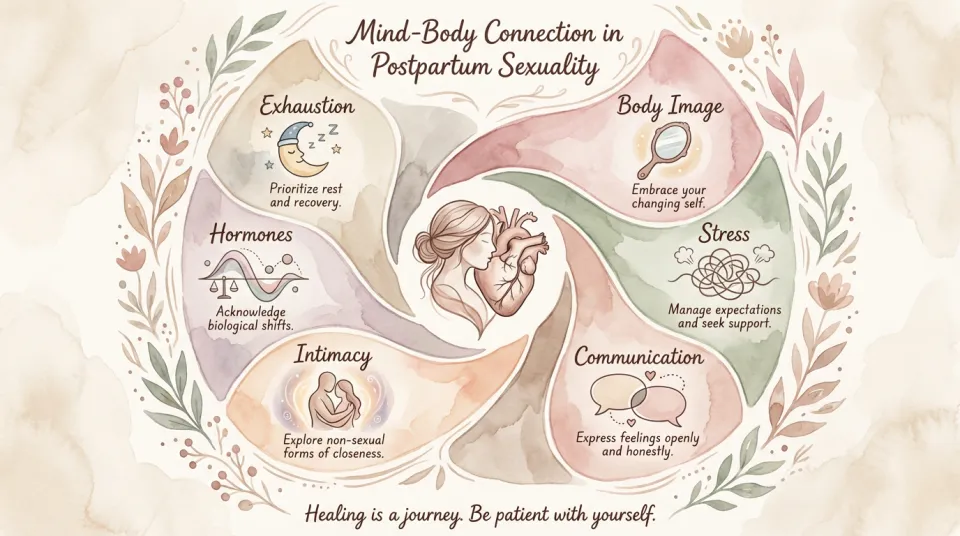
Exhaustion, Sleep Deprivation, and Mental Overload
You are tired. Always. Your body is running in survival mode, and your nervous system is under constant stress. But for desire and arousal, relaxation, safety, and mental capacity are needed – things that are currently in short supply.
- Short term: Lower your expectations. Intimacy can also be cuddling, massage, or showering together. Not every encounter has to lead to orgasm.
- Long term: Organize regular breaks – even if it's just 20 minutes. Sleep when the baby sleeps. Ask for help so you have energy for yourself (and your relationship).
Altered Body Image and Self-Esteem
Your body looks different. You might feel alien in your own skin, insecure, unattractive. These thoughts block arousal and surrender – and thus also orgasm.
- Short term: Talk to your partner about your feelings. Often, he sees you quite differently than you see yourself. Compliments and affirmation can work wonders.
- Long term: Work on self-acceptance. Your body has given life – that is powerful and beautiful. Body-neutrality ("My body is functional and valuable") may be easier than body-positivity.
Changed Relationship Dynamics and Communication
You are now parents – a new role that takes up a lot of space. Perhaps there is not enough time for just the two of you, or the relationship feels more like a partnership of convenience. Without emotional connection, sexual fulfillment is difficult.
- Short term: Consciously plan couple time – even without sex. Talk about your needs, fears, and desires. Open communication is the basis for good sex.
- Long term: Consider couples counseling or sex therapy if problems persist. Seeking support is not a sign of weakness but of strength.

Strategies for Short-Term and Long-Term Solutions: Your Path Back to Desire
Orgasm problems after birth are normal – but they don’t have to be permanent. Here are concrete steps that can help you:
Short-Term Strategies (0–6 Months Postpartum)
- Remove the pressure: Orgasm is not a must. Focus on closeness, touch, and pleasure without a goal.
- Use lubricant: Use it generously and without shame – it makes everything more pleasant.
- Self-pleasure: Explore your body alone, without performance pressure. What feels good? What has changed?
- Communication: Openly discuss your needs, fears, and boundaries with your partner.
- Give it time: Hormonal recovery takes up to 9 months. Your body is healing – trust the process.
Long-Term Strategies (6+ Months Postpartum)
- Pelvic floor training: Regular exercises (e.g., with an app, physiotherapist, or postpartum course) strengthen muscles and sensation.
- Hormone check: If problems persist after weaning, get your hormone status checked.
- Couples therapy: If the relationship suffers, seek professional support.
- Sex therapy: Specialized therapists can provide targeted help for orgasm problems.
- Self-care: Invest in yourself – sleep, exercise, nutrition, mental health. Your sexuality will benefit from it.

If-Then FAQ: Your Questions, Our Answers
If I’m breastfeeding – is it normal that I don't have orgasms anymore?
Yes, absolutely. High prolactin and low estrogen/testosterone levels dampen libido and the ability to orgasm. This usually normalizes after weaning. Use lubricant and take the pressure off.
If I had a perineal tear – can I still have orgasms?
Yes! Even after birth injuries, the body recovers. Pelvic floor training and time are crucial. It may take longer with more severe tears – speak with your gynecologist.
If I don't feel comfortable in my body anymore – how can I still feel desire?
Speak openly with your partner, work on self-acceptance (body-neutrality helps!), and focus on sensations rather than appearance. Therapeutic support can be valuable.
If my partner and I have become estranged – will that help with orgasm problems?
Yes, emotional connection is the foundation for good sex. Consciously plan couple time, talk about needs, and consider couples counseling if necessary.
If nothing changes after 9 months – is something wrong?
Not necessarily, but it’s worth seeking professional help. Gynecologists (hormone check), pelvic floor physiotherapists, or sex therapists can provide targeted support.
If I have no desire for sex – do I still have to try to orgasm?
No! Pressure makes everything worse. Intimacy without orgasm is valuable. Listen to your body and communicate your boundaries clearly.
You Are Not Alone – and It Will Get Better
Orgasm problems after birth are widespread, temporary, and solvable. Your body has achieved something incredible and needs time, patience, and support to heal. Whether it’s hormonal recovery, pelvic floor training, or emotional work – there are concrete steps that can help you.
Talk openly about your experiences – with your partner, your doctor, a therapist, or other mothers. You are not broken. You are not alone. And yes: Your desire will come back.
Article translated from German → View original article
Sources & Research
Research Summary
Nach der Geburt erleben viele Mütter Orgasmusprobleme aufgrund hormoneller Veränderungen, Beckenbodenverletzungen und psychischer Belastungen. Häufige körperliche Ursachen umfassen hohen Prolaktinspiegel beim Stillen, Östrogenmangel und Geburtsverletzungen, während psychologische Faktoren wie Müdigkeit und Stress eine Rolle spielen. Strategien wie Beckenbodentraining, Zeit geben und offene Kommunikation fördern die Besserung, die bis zu 9–18 Monate dauern kann.
Sources Used
- Sexualität und Partnerschaft nach der Geburt (Accessed on 2026-01-23)
- Keinen Orgasmus nach der Geburt (Accessed on 2026-01-23)
- Sexleben nach der Geburt - Alles anders? Ganz normal! (Accessed on 2026-01-23)
- Studie: Sexuelle Funktion nach Geburt (Accessed on 2026-01-23)
- Therapieempfehlung für Sexualstörungen nach einer Geburt (Accessed on 2026-01-23)
- Entbindungsmethoden und ihre Auswirkungen auf den Sex (Accessed on 2026-01-23)
- Ab wann ist Sex nach der Geburt wieder erlaubt? (Accessed on 2026-01-23)
- Sex nach der Geburt: Wann die Lust wiederkehrt (Accessed on 2026-01-23)
- Ruiniert eine vaginale Geburt das Sexleben? Ärzte und Hebamme antworten (Accessed on 2026-01-23)
Medical Disclaimer
The information provided in this article is for educational purposes only and is not intended as a substitute for professional medical advice, diagnosis, or treatment. Always seek the advice of your physician or other qualified health provider with any questions you may have regarding a medical condition. Never disregard professional medical advice or delay in seeking it because of something you have read on this website.
Similar Posts
Rediscovering Your Desire: The Gentle Restart After a Long Break
After months or years without sex, does everything feel foreign? You are not alone. Learn why breaks are completely norm...
Medications Dampen Your Desire? What You Need to Know Now
Many medications significantly affect libido and orgasm ability. Here you will learn which substances typically cause pr...
Masturbation in Relationships: How to Talk Openly and Without Jealousy
Masturbation is normal – even in relationships. Yet, secrecy creates distance. Learn how to talk openly and relaxedly ab...
Breastfeeding as an Intimate Experience: How to Recognize and Lovingly Protect Your Boundaries
Breastfeeding is pure closeness – yet it can sometimes trigger unexpected physical or emotional reactions. You are not a...