You lie in bed, your partner cuddles up to you – and in your head, it’s racing: Packing lunchboxes for tomorrow, rescheduling the pediatrician appointment, hanging up laundry, buying a birthday gift... The touch feels like just another task on your list. Mental load – this invisible, constant burden – lays like a glass pane between you and your desire. But there is a way out: targeted relief that gives your mind space and allows your body to feel again.

Why Mental Load Blocks Your Libido
Mental load doesn’t just mean having many tasks – it means having to constantly think about everything. You are the manager of family life: you know when the diapers are running out, who wears what shoe size, when the next vaccination is due. This cognitive constant stress activates your stress system – which is the natural antagonist to your libido.
Sexual arousal requires presence, security, and relaxation. When your nervous system is running in survival mode, it shuts down everything that isn’t immediately life-threatening – and unfortunately, that includes desire. Your body says: "Now is not the time for sex, we have too much to do." This is not a character flaw, but pure biology.

The Role of Mental Load Relief for Sexual Health
Mental relief is not a luxury – it is a prerequisite for physical well-being. If you are constantly overloaded, your body produces stress hormones like cortisol, which suppresses sexual hormones like estrogen and testosterone. The result: you feel tired, irritable, and sexually uninterested.
But if you actively reduce mental load, the opposite happens: your nervous system relaxes, your body can switch back into "rest-and-digest" mode – and suddenly there is space again for desire, curiosity, and connection. Sexual health begins in the mind, not in the bedroom.
10 Practical Relief Deals to Improve Libido
These levers are not quick tricks, but structural changes that will help you reduce mental load and reclaim your libido in the long run. Choose 2-3 that feel most urgent to you – and implement them consistently.
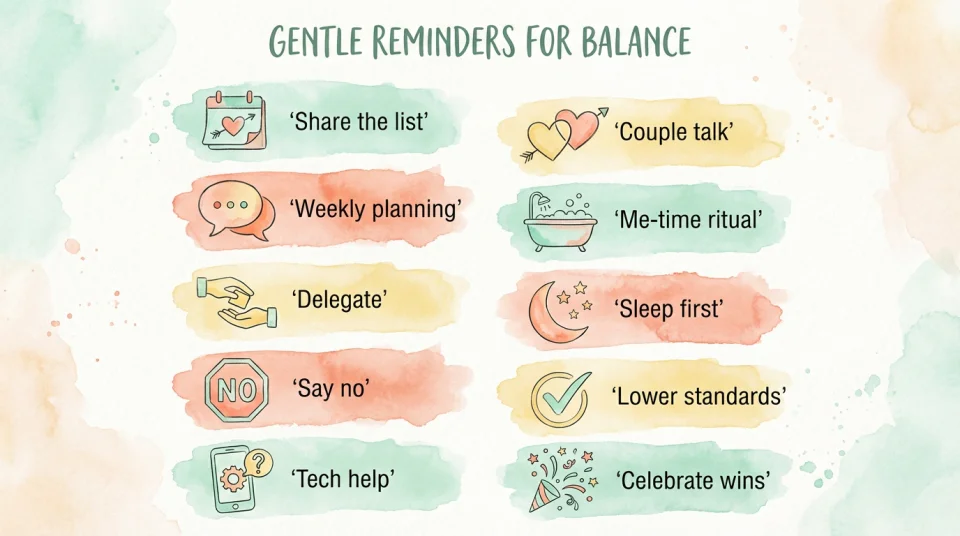
- 1. Make the Invisible Work Visible: Write down together who is thinking about what. Often, just awareness is enough to redistribute tasks.
- 2. Weekly Planning as a Couple: Spend 20 minutes each Sunday planning for the upcoming week. Who picks up the kids when? Who does the shopping? Who cooks?
- 3. Radically Delegate: Not everything has to be perfect. Your partner can pack the lunchboxes differently. The kids can have convenience meals once in a while.
- 4. Say No to Additional Tasks: Nursery festival committee, neighbor help, organizing birthday parties – not everything has to come from you.
- 5. Use Technology: Shared shopping list apps, shared calendars, meal planning tools – let technology help.
- 6. Talk About Expectations: What does "clean apartment" mean to both of you? Where can you lower standards?
- 7. Consciously Schedule Me-Time: Once a week, dedicate an hour just for yourself – non-negotiable. Without this time, there’s no energy for intimacy.
- 8. Prioritize Sleep: Fatigue is the biggest libido killer. Sometimes going to bed early is more important than couple time.
- 9. Consciously Lower Your Standards: The apartment doesn’t always have to be tidy. Perfection costs energy that you need for desire.
- 10. Celebrate Small Wins: If a week went well, acknowledge it together. Positive reinforcement motivates in the long run.

Solo Sex as a Bridge to More Desire
Many mothers feel that sexuality can only occur in a couple – but solo sex is a powerful form of self-care. It helps you reconnect with your body without performance pressure, without expectations, and without mental load.
If you regularly spend time with yourself – whether through masturbation, sensual touches, or simply conscious sensing – you train your nervous system to switch back into desire mode. You learn what feels good, what excites you, what you need. And this knowledge can be brought into couple sexuality later on.
Solo sex is not a substitute for intimacy with a partner – it is a bridge. It shows your body: "It is safe to feel desire. It is allowed to enjoy." And that is often the first step back to fulfilling sexuality.

Your Relief Deal: Small Steps, Big Impact
Change doesn’t need a revolution – it needs consistency in small steps. Choose the two levers from the 10 that feel most urgent. Talk to your partner about it. Sit down together and make a concrete plan: Who takes over what? When will you have your weekly planning? When is your me-time?
And then: Stick to it. Not perfectly, but consistently. Because sexual desire doesn’t return overnight – but it comes back when you give it space. When your mind isn’t racing all the time. When you feel again that you are more than just a manager of daily life.
You deserve to feel alive again. You deserve to experience desire – not as an obligation, but as a gift to yourself. And the first step toward that is sharing the burden you have carried alone for far too long.
Article translated from German → View original article
Medical Disclaimer
The information provided in this article is for educational purposes only and is not intended as a substitute for professional medical advice, diagnosis, or treatment. Always seek the advice of your physician or other qualified health provider with any questions you may have regarding a medical condition. Never disregard professional medical advice or delay in seeking it because of something you have read on this website.
Similar Posts
Rediscovering Your Desire: The Gentle Restart After a Long Break
After months or years without sex, does everything feel foreign? You are not alone. Learn why breaks are completely norm...
Medications Dampen Your Desire? What You Need to Know Now
Many medications significantly affect libido and orgasm ability. Here you will learn which substances typically cause pr...
Masturbation in Relationships: How to Talk Openly and Without Jealousy
Masturbation is normal – even in relationships. Yet, secrecy creates distance. Learn how to talk openly and relaxedly ab...
Breastfeeding as an Intimate Experience: How to Recognize and Lovingly Protect Your Boundaries
Breastfeeding is pure closeness – yet it can sometimes trigger unexpected physical or emotional reactions. You are not a...