
You lie in bed, your partner gently strokes your arm – and instead of anticipation, you feel only tension. Your body feels different, perhaps still sore, perhaps unfamiliar. After a cesarean section or a perineal injury, this is completely normal. The good news: desire returns – at your pace, in your own way.

Body Positivity: Healing vs. Feeling "Ready"
Your body has accomplished a miracle – and it bears the marks of this. A cesarean scar, a healed perineal tear: these are not blemishes, but signs of your strength. Nevertheless, you may find that you no longer feel at home in your skin.
Healing takes time. A perineal injury heals in about three weeks, but pain or discomfort can last weeks or even months longer. For a cesarean section, internal healing can take up to six months. This means: Being ready is not the same as being healed.
- Give yourself permission to wait. There is no timeline for desire – neither after six weeks nor after six months.
- Mourn if necessary. You may miss your "old" body feeling. You are allowed to acknowledge this without feeling guilty.
- Celebrate small progress. A day without pain, a moment when you feel beautiful again – that counts.
Your body is not broken. It is in transition – and that is allowed to take time.
Recalibrating Physical Contact: From Touch to Desire
You may feel "drained" from constant nursing, carrying, and diapering. Your body feels like it belongs to everyone – except you. Therefore, intimacy does not begin in the bedroom, but at the rediscovery of your own boundaries.

Step 1: Touch Without Expectation
Start with non-sexual touch. A hand massage, applying lotion together, an embrace without ulterior motive. This helps your nervous system to experience touch again as pleasant rather than as a demand.
- Clearly communicate to your partner what feels good – and what does not.
- Use a "traffic light system": Green = good, Yellow = uncertain, Red = please stop.
- Intentionally schedule "cuddle times" where sex is explicitly not the topic.
Step 2: Postpartum Exercises as a Source of Desire
Postpartum exercises strengthen not only your pelvic floor – they help you to regain your body awareness. When you feel that you can regain control of your pelvic floor, your confidence in intimate moments also grows.
- Practice pelvic floor exercises daily (e.g., tightening while exhaling, releasing while inhaling).
- Try gentle yoga or Pilates – movements that bring you into your body.
- Note: If you experience pain or uncertainty, be sure to consult a specialized physiotherapist.
When Physiotherapy or a Doctor is Advisable
Sometimes, patience alone is not enough. If you still experience pain while sitting, walking, or touching months after childbirth, seek professional help. This is not a sign of weakness – but of self-care.
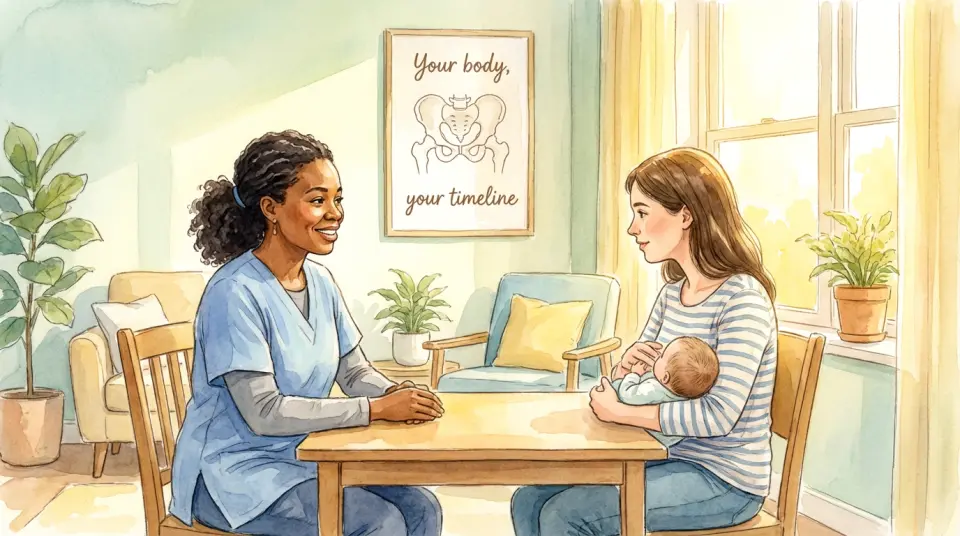
Consult a doctor or physiotherapist if:
- Pain during intercourse persists even after six months
- You feel scar tissue that is hard or tight
- You have issues with incontinence or numbness
- You feel emotionally blocked and do not know how to move forward
A pelvic floor physiotherapist can mobilize scar tissue, relieve tension, and show you how to "reinhabit" your body. Your gynecologist can check if everything has healed well – and refer you if necessary.
3 Gentle Re-Entry Routines for More Desire
You don't have to go from zero to a hundred. These three routines will help you regain step by step trust and desire – without pressure, without pain.

Routine 1: The Scar Massage Routine (from 6 weeks postpartum)
Scar tissue can harden and cause pain. A gentle massage makes it more supple – and helps you to accept your body again.
- When: Daily for 5 minutes, e.g., after showering
- How: Use a nourishing oil (almond oil, vitamin E oil). Massage the scar with circular motions – first gently, then with light pressure.
- Tip: Breathe consciously during this. Inhale "I trust," exhale "I let go."
Routine 2: The Lubricant-and-Patience Routine
Hormonal dryness is completely normal after childbirth – especially while breastfeeding. Lubricant is your friend, not a sign of "failure."
- When: At every intimate contact, even during foreplay
- How: Choose a water-based, fragrance-free lubricant. Apply generously – more is more.
- Tip: Experiment with different positions. Often positions where you are in control (e.g., on top) are more pleasant.
Routine 3: The "Desire Map" Routine
Your body has changed – perhaps other areas are now more sensitive. Discover what feels good now.
- When: Once a week, alone or with a partner
- How: Take 15 minutes. Touch different parts of your body (neck, inner arms, thighs, belly) – without a goal, just to explore.
- Tip: Write down what feels good. Share it with your partner if you like.

Your Desire, Your Pace – Without Guilt
There is no "right" time to become intimate again. Some women feel ready after weeks, others need months – or longer. Both is okay.
Be open with your partner about your fears, desires, and boundaries. Intimacy is not just about intercourse – it includes the small moments: a kiss, a laugh, a "I see you." And if you realize that emotional blocks are in the way, do not hesitate to seek professional support – whether from a therapist, a sexual advisor, or your midwife.
Your body has accomplished a miracle. Now it is allowed to heal, to reinvent itself – and to learn to enjoy again. At its own pace. At your pace.
Article translated from German → View original article
Sources & Research
Research Summary
Der Artikel richtet sich an Mütter nach Kaiserschnitt oder Dammverletzung und bietet sensible Wege zur Wiederentdeckung von Lust und Sexualität. Er betont Body Positivity, Neukalibrierung von Körperkontakt, wann Physiotherapie oder Arztbesuche sinnvoll sind, und stellt drei sanfte Wiedereinstiegsroutinen vor. Der Ton ist verständnisvoll und unterstützend, um Heilung und Selbstakzeptanz zu fördern.
Sources Used
- Nach der Geburt: Der ganz normale “Lustverlust“ (Accessed on 2026-01-23)
- Sex nach der Geburt: Hier bekommen Sie Antworten (Accessed on 2026-01-23)
- Sex nach der Geburt: Wie lange Paare warten sollten (Accessed on 2026-01-23)
- Dammriss und Sexualität: Kein Widerspruch (Accessed on 2026-01-23)
- sex nach geburt (Dammschnitt/ scheidenriss) (Accessed on 2026-01-23)
- Sex nach Geburt – wann ist der richtige Zeitpunkt und auf ... (Accessed on 2026-01-23)
- Sexualität nach der Geburt (Accessed on 2026-01-23)
- Sexualität nach der Geburt – Schmerzen, Lustverlust und ... (Accessed on 2026-01-23)
- Sex nach Geburt: Tipps und Verhütung (Accessed on 2026-01-23)
- Sex nach der Geburt: Wann die Lust wiederkehrt (Accessed on 2026-01-23)
Medical Disclaimer
The information provided in this article is for educational purposes only and is not intended as a substitute for professional medical advice, diagnosis, or treatment. Always seek the advice of your physician or other qualified health provider with any questions you may have regarding a medical condition. Never disregard professional medical advice or delay in seeking it because of something you have read on this website.
Similar Posts
Rediscovering Your Desire: The Gentle Restart After a Long Break
After months or years without sex, does everything feel foreign? You are not alone. Learn why breaks are completely norm...
Medications Dampen Your Desire? What You Need to Know Now
Many medications significantly affect libido and orgasm ability. Here you will learn which substances typically cause pr...
Masturbation in Relationships: How to Talk Openly and Without Jealousy
Masturbation is normal – even in relationships. Yet, secrecy creates distance. Learn how to talk openly and relaxedly ab...
Breastfeeding as an Intimate Experience: How to Recognize and Lovingly Protect Your Boundaries
Breastfeeding is pure closeness – yet it can sometimes trigger unexpected physical or emotional reactions. You are not a...