It's 9:30 PM. You've put your child back to bed for the third time, patience is wearing thin, and you're wondering: Why is falling asleep just not working? Often, we overlook how much the sleep environment makes the difference between endless bedtime battles and peaceful nights. The good news: With a few targeted adjustments, you can create a bedroom that helps your child calm down and sleep through the night.

The Perfect Temperature: Sleeping Better in a Cool Room
Imagine trying to fall asleep in an overheated room—impossible, right? Children feel the same way. The ideal bedroom temperature is about 18 degrees Celsius. This may sound cool at first, but this temperature supports your child's natural sleep cycle.
At night, the body lowers its core temperature to slip into deep sleep. A room that is too warm disrupts this process and leads to restless sleep. Make sure your child sleeps in a breathable sleeping bag or with an appropriate blanket—not too thick and not too thin.
- Use a room thermometer to monitor the temperature
- Ventilate briefly before bedtime with the window fully open (5-10 minutes)
- Avoid constant ventilation with tilted windows as this promotes mold growth
- Adjust your child's sleepwear to the season, not the room temperature

Darkness and Light: Finding the Right Balance
Light is one of the strongest regulators for our internal clock. When it gets dark, the body produces melatonin—the sleep hormone. A darkening bedroom is therefore worth its weight in gold.
Especially in the summer, when it stays light outside for a long time in the evenings, blackout curtains or blinds help create the right sleep atmosphere. But be careful: not every child manages complete darkness.
If Your Child Needs a Night Light
Many children feel uncomfortable in total darkness. This is completely normal. If your child needs a night light, choose a red night light—this light color disrupts melatonin production the least. Avoid blue or white light, as it keeps the body awake.
- Invest in good blackout curtains or blinds
- If necessary, use a dimmable red night light
- Turn off all electronic devices with indicator lights or cover them up
- For nighttime feeding: touch-sensitive night lamps that can be easily turned on and off

The Power of Routine: Rituals That Provide Security
Children love predictability. A fixed evening routine signals the body: It’s time for bed. In the last two hours before bedtime, things should quiet down—no wild play, no roughhousing, no exciting movies.
Instead: cuddle time, reading, soft music, a warm bath or quiet coloring. These activities help your child to wind down internally. Consistent bedtimes and wake-up times support the internal clock and make falling asleep easier—even on weekends.
The Bed is for Sleeping
An important point: The bed should be associated solely with sleep. Homework, playing, eating, or screen time do not belong in bed. This way, your child’s brain learns: bed means sleep.
- Establish a consistent evening routine (e.g., bath → brushing teeth → story → lullaby)
- Plan 20-30 minutes for the routine
- Keep bedtimes and wake-up times consistent (even on weekends)
- Avoid exciting activities in the last two hours before sleep
- Use the bed only for sleeping, not for playing
Reduced Stimulation Environment: Less is More
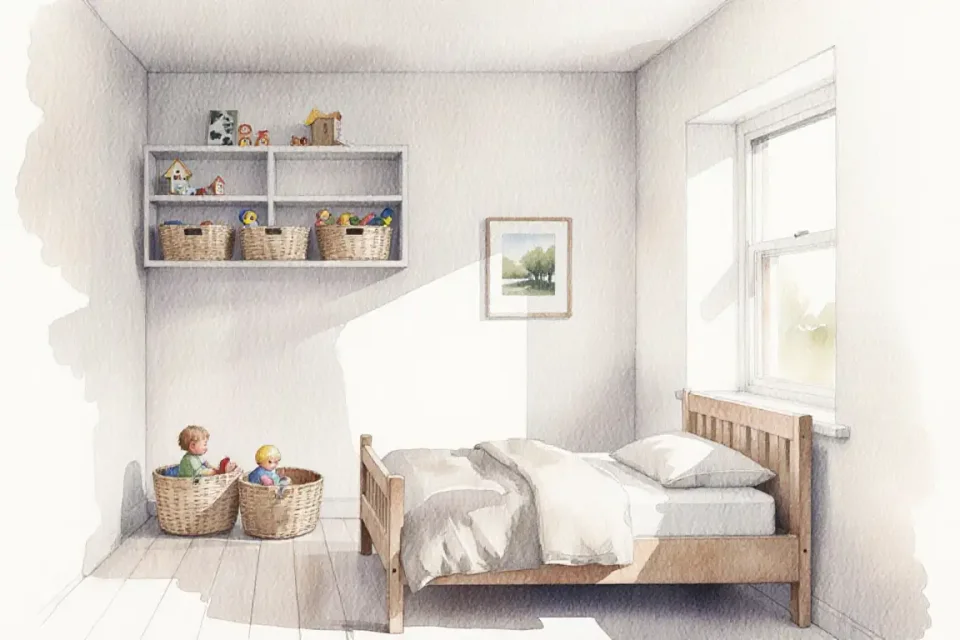
Too many toys, colorful posters, blinking lights—all of this can distract your child from sleeping. A tidy, low-stimulation room has a calming effect and gives your child a sense of order and security.
This doesn’t mean the room has to be sterile. Simply choose a few calming decorations: perhaps a gentle mobile, a plush toy, or a simple wall art in muted colors. Store toys in closed boxes or cabinets so they're not visible in the evening.
- Clean up together with your child before bedtime
- Use closed storage systems for toys
- Choose calming colors for walls and textiles (pastels, earth tones)
- Avoid too many visual stimuli on the walls
- Create a clear distinction between play area and sleep area
Safety for the Small Ones: Proper Placement of the Baby Crib
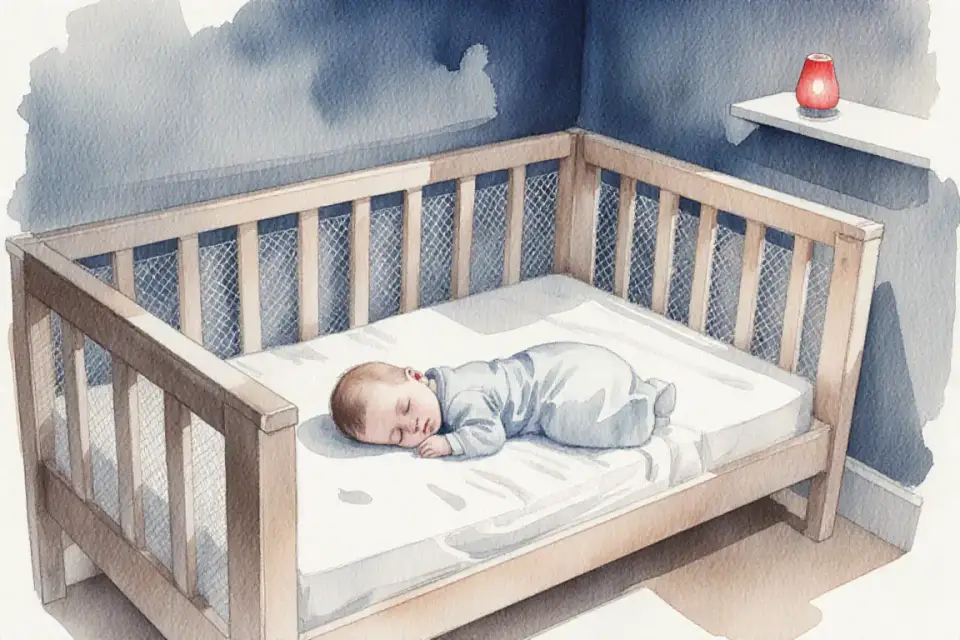
Special recommendations apply for babies in their first year of life. The baby crib should be in the parents' bedroom—this provides closeness and security and makes nighttime feeding or comforting easier.
Ensure the crib is safely placed: no lamps, outlets, cords, or picture frames within reach. The environment should be smoke-free, and the crib itself should only be equipped with a firm mattress and a suitable sleeping bag—no pillows, blankets, or plush toys in the first year.
Frequently Asked Questions About the Sleep Environment
How dark should it really be?
As dark as possible as long as your child feels comfortable. Use a weak red night light if necessary.
My child sweats at night—is the room too warm?
Probably. Check the room temperature and possibly reduce the blanket or sleeping bag.
Can my child have stuffed animals in bed?
From about one year old, a stuffed animal is okay. In the first year, the bed should be clear of loose items.
How often should I ventilate?
At least once before bedtime for 5-10 minutes with the window fully open. In the morning, also ventilate briefly.
What if my child is afraid of the dark?
Take their fears seriously. A night light, open doors, or a plush toy can help. Don’t force your child into darkness.
Your Path to Peaceful Nights
Creating a relaxed sleep environment isn’t rocket science—but it does require attention to detail. Temperature, light, routine, and a low-stimulation environment are the four pillars on which good children's sleep rests.
Start with small steps: measure the room temperature, darken the room, establish an evening routine. You'll notice how the quality of your child's sleep—and therefore your own—improves. Sleep isn’t just a matter of luck, but often a question of the right environment. You can do it!
Article translated from German → View original article
Sources & Research
Research Summary
Eine entspannte Schlafumgebung für Kinder entsteht durch ein ruhiges, abdunkelbares und angenehm temperiertes Zimmer, das frei von Ablenkungen ist. Feste Rituale am Abend und ein regelmäßiger Schlafrhythmus unterstützen das Einschlafen und fördern erholsamen Schlaf. Zudem ist eine sichere, reizarme Umgebung ohne störende Lichtquellen und mit geeigneter Bettwäsche essenziell.
Sources Used
- 7 Tipps, wie Eltern den Schlaf ihres Kindes fördern (Accessed on 2025-10-27)
- Die richtige Schlafumgebung für das Baby (Accessed on 2025-10-27)
- Schlafstörungen als Mutter: 6 Tipps für erholsamere Nächte (Accessed on 2025-10-27)
- Einschlaf-Tipps für Kinder von zwei bis fünf Jahren (Accessed on 2025-10-27)
- Schlafumgebung für Babys: Infos & Tipps (Accessed on 2025-10-27)
- Die optimale Schlafumgebung | Ideen fürs Babyzimmer (Accessed on 2025-10-27)
- www.fritzundfraenzi.ch/7-tipps-wie-eltern-den-schlaf-ihres-kindes-foerdern (Accessed on 2025-10-27)
- www.kindergesundheit-info.de/themen/schlafen/0-12-monate/schlafumgebung/ (Accessed on 2025-10-27)
- www.orthomol.com/de-de/lebenswelten/schwangerschaft-stillzeit/schlafstoerungen-mutter (Accessed on 2025-10-27)
- www.elternleben.de/kleinkind/gesundheit-ernaehrung/schlaftipps-fuer-kleinkinder/ (Accessed on 2025-10-27)
- www.bebafamily.de/magazin/schlafumgebung (Accessed on 2025-10-27)
- www.ehrenkind.de/blogs/magazin/optimale-schlafumgebung-babyzimmer (Accessed on 2025-10-27)
- doreenbrumme.de/2021/01/schlafumgebung-im-kinderzimmer/ (Accessed on 2025-10-27)
- www.familienportal.nrw/de/0-bis-1-jahre/gesundheit-kind/tipps-fuer-eine-sichere-schlafumgebung (Accessed on 2025-10-27)
- www.springermedizin.de/schlaf-wach-stoerungen/somnologie/33-praxis-tipps-fuer-muede-eltern-um-ueber-den-tag-zu-kommen/27022136 (Accessed on 2025-10-27)
- www.stern.de/panorama/kindererziehung--schlaf-expertin-teilt-tipps-fuer-junge-eltern-33836086.html (Accessed on 2025-10-27)
Medical Disclaimer
The information provided in this article is for educational purposes only and is not intended as a substitute for professional medical advice, diagnosis, or treatment. Always seek the advice of your physician or other qualified health provider with any questions you may have regarding a medical condition. Never disregard professional medical advice or delay in seeking it because of something you have read on this website.
Similar Posts
Tips for More Self-Compassion: How to Speak Gently to Yourself
Do you know that harsh voice in your head telling you that you're not enough? Learn how to talk to yourself the way you ...
Sleep Deprivation? Turn the Night into a Heroine instead of Horror
Your baby wakes up for the fifth time, and you feel like a zombie? Discover how to make sleep deprivation not only more ...
Why Your "Mistakes" as a Mother are Exactly What Your Child Needs
Forgotten lunchboxes, impatience in the evening, a chaotic household – what if these "imperfect" moments make your child...
Meal Prep for Moms: 7 Energetic Recipes You Can Cook in 2 Hours
Between childcare, household chores, and everything else, there's hardly any time left for cooking. Discover how to prep...