You finally sit on the edge of the bed, the door is closed, five minutes of peace – and yet your mind keeps racing. The to-do list, the unwashed dishes, the worry that the child will wake up again. Your body feels like an engine that can't find neutral. This is where a often overlooked tool comes in: conscious, loving touch – not as a performance, but as a nervous system reset. In just five minutes, you can signal to your body: "You are allowed to arrive here."

Why Your Body Sometimes Doesn’t “Turn On” – and What’s Behind It
Perhaps you know this: You intend to do something good for yourself, but instead of relaxation, you feel… nothing. Or restlessness. Or guilt. This is not about you – but about your nervous system. When you are constantly in stress mode (sympathetic nervous system active), your body remains on high alert. Pleasure, relaxation, and enjoyment need the opposite: the parasympathetic nervous system, the part of your nervous system responsible for rest and regeneration.
Studies show that ritualized breathing exercises can act like a reset button. Just a few deep breaths regulate the nervous system and activate the parasympathetic nervous system. So, your body first needs the permission to relax before it can even allow pleasure. That's why the path to enjoyment is often more important than the goal itself.
- Your nervous system is not a switch – it needs transitions to switch from stress to relaxation mode.
- Chronic stress blocks pleasure – not because you are “broken,” but because your body is stuck in survival mode.
- Micro-rituals help – small, repeatable actions signal to your body: "It’s safe here."
Micro-Rituals for Self-Soothing: Breathing and Setting Boundaries
Before you even think about touch, create a safe space. This can be as simple as: locking the door, muting your phone, lighting a candle. These small actions are more than just decoration – they are rituals that tell your nervous system: "Now is time for me."

A study by Hobson et al. (2017) shows that rituals after failures reduce stress and regulate emotional responses. This can be as simple as rubbing your hands together, a small mantra ("I am here, I am safe"), a stone in your hand, or a quick "shaking it out" of your body. Try out what feels right for you.
The 4-6 Breathing Exercise: Your 60-Second Reset
This technique is scientifically proven and very easy: Inhale for 4 seconds, exhale for 6 seconds. Studies show that this breathing technique lowers your heart rate, activates the parasympathetic nervous system, and helps you calm down within 60 seconds. Repeat it 5-8 times before you touch yourself. You'll notice: Your body becomes softer, your breath deeper, your mind calmer.
- Inhale through your nose (count slowly to 4)
- Exhale through your mouth (count slowly to 6)
- Imagine that you are taking in "calm" when you inhale, and releasing "tension" when you exhale
Setting Boundaries – Even with Yourself
You don't have to achieve anything. No orgasm, no "perfect" relaxation, no specific duration. Set a boundary for yourself: "I will take 5 minutes just to feel." This removes the pressure and gives you the freedom to simply be present. If you like, you can also set a gentle reminder (e.g., a timer with a soft sound) so you don't have to keep checking the clock.
Myth Check: What You DON’T Need to Experience Pleasure
Let’s debunk some persistent myths that might be getting in your way:
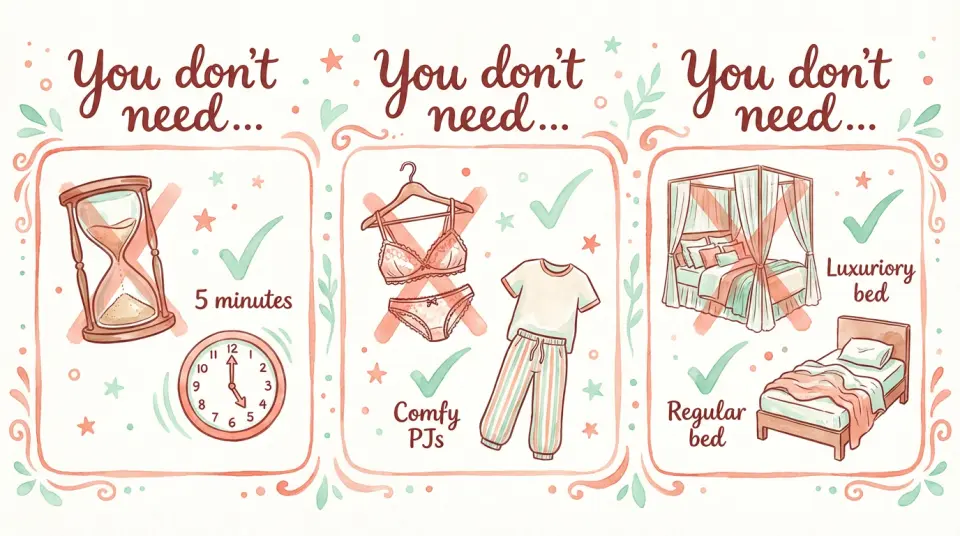
- Myth 1: "I need at least 30 minutes." – No! Five minutes of conscious touch can accomplish more than half an hour without heart. Quality trumps quantity.
- Myth 2: "I have to feel sexy." – Wrong. You can come in sweatpants, unwashed, with a mom bun. Your body deserves pleasure, no matter how you look.
- Myth 3: "It has to lead to orgasm." – Nope. The goal is connection with yourself, not performance. Sometimes the goal is simply: "I feel myself again."
- Myth 4: "I need toys or special equipment." – No. Your hands, your breath, your attention are more than enough. Everything else is optional.
- Myth 5: "I should feel relaxed right away." – Unreasonable. Sometimes first comes restlessness, thoughts, or tears. That’s okay – it’s part of the process of coming back to yourself.
Your 3-Day Mini-Challenge: Nervous System Reset in Action
Ready to try it out? This challenge is intentionally accessible – no pressure, no musts, just gentle invitations. Choose what feels right for you.
Day 1: Arriving in Your Body
Your task: 5 minutes just for you. Close the door, do the 4-6 breathing exercise (5x), then place one hand on your heart, one on your belly. Just feel your breath, your warmth. No touch "down there" – just presence. Ask yourself at the end: "What do I really need right now?"

Day 2: Touch as Exploration
Your task: Again, 5 minutes. Start with the breathing exercise, then touch yourself curiously – not goal-oriented. Glide over your arms, your belly, your thighs. If you like, also over your vulva – but without expectation. Ask yourself: "Where does touch feel good? Where neutral? Where uncomfortable?" It’s about body knowledge, not arousal.
Day 3: Pleasure as Self-Care
Your task: 5 minutes with the permission to feel pleasure – when it comes. Start again with breathing and ritual. Then touch yourself the way it feels good today. Maybe gently, maybe more intensely, maybe not at all. Let your body lead. If thoughts arise ("I should be..."), exhale them and return to touch. At the end: Gratitude for this time with yourself.
What You Can Take Away: Pleasure is Not a Luxury, But Nervous System Care
These five minutes are not about self-optimization – they are self-recognition. You’re sending your body the message: "You are allowed to experience pleasure. You are allowed to relax. You are worth it." That is radical self-care in a world that expects constant availability from mothers.

Perhaps you won’t find these five minutes every day – and that’s okay. But when you do, use them mindfully. Your nervous system will thank you. Your patience with your children will grow. Your connection to yourself will deepen. And perhaps you’ll realize: Pleasure is not something you “do” – but something that arises when you give yourself space.
You are not selfish if you take this time for yourself. You are wisely. Because a mother who is allowed to arrive with herself can truly be there for others – without losing herself in the process.
Article translated from German → View original article
Sources & Research
Research Summary
Die verfügbaren Suchergebnisse enthalten keine spezifischen Informationen zu Selbstbefriedigung als Nervensystem-Reset oder zu Lust als Selbstfürsorge-Methode für Mütter. Die Ergebnisse behandeln allgemeine Achtsamkeits- und Entspannungsrituale wie Atemübungen, Meditation und Mikro-Routinen für gestresste Mütter, aber nicht das spezifische Thema der sexuellen Selbstfürsorge.
Sources Used
- Mom Circles: Stärkende Rituale für Schwangere & Mütter (Accessed on 2026-01-23)
- Innere Stärke finden: 5 kleine Rituale für deinen Alltag (Accessed on 2026-01-23)
- Selbstgefühl stärken: 7 kleine Rituale mit großer Wirkung (Accessed on 2026-01-23)
- Mom Circles: Stärkende Rituale für Schwangere & Mütter (Accessed on 2026-01-23)
- Geführte Meditation für Mütter 🤱|| 100% Stress loslassen (Accessed on 2026-01-23)
- Selbstgefühl stärken: 7 kleine Rituale mit großer Wirkung (Accessed on 2026-01-23)
- Abendritual für Mamas: So entspanne ich nach einem ... (Accessed on 2026-01-23)
- Innere Stärke finden: 5 kleine Rituale für deinen Alltag (Accessed on 2026-01-23)
- Mutter-Tochter Ritual (Accessed on 2026-01-23)
- 5 Achtsamkeits-Rituale für Mütter | Kraft im Alltag (Accessed on 2026-01-23)
- Wie kleine Rituale für ein geborgenes Zuhause sorgen (Accessed on 2026-01-23)
- Rituale. - Wie kleine Gewohnheiten deine Resilienz stärken (Accessed on 2026-01-23)
Medical Disclaimer
The information provided in this article is for educational purposes only and is not intended as a substitute for professional medical advice, diagnosis, or treatment. Always seek the advice of your physician or other qualified health provider with any questions you may have regarding a medical condition. Never disregard professional medical advice or delay in seeking it because of something you have read on this website.
Similar Posts
Rediscovering Your Desire: The Gentle Restart After a Long Break
After months or years without sex, does everything feel foreign? You are not alone. Learn why breaks are completely norm...
Medications Dampen Your Desire? What You Need to Know Now
Many medications significantly affect libido and orgasm ability. Here you will learn which substances typically cause pr...
Masturbation in Relationships: How to Talk Openly and Without Jealousy
Masturbation is normal – even in relationships. Yet, secrecy creates distance. Learn how to talk openly and relaxedly ab...
Breastfeeding as an Intimate Experience: How to Recognize and Lovingly Protect Your Boundaries
Breastfeeding is pure closeness – yet it can sometimes trigger unexpected physical or emotional reactions. You are not a...